Yesterday Jude was scheduled for an X-ray at a Dr. who is not our regular. As is the custom, I was handed a clipboard bulging at the top with a sheaf of papers. I laid Jude's blanket on the floor, and plopped her down to play with her teething toy. As she cooed, laughed and tried to crawl around, I filled out paper work looking up every few moments to smile at her and chat. She was perfect there before me, her eyes bright and curious, taking in all the new things to see. There was a three day old baby there, and her parents were charmed with Jude who flirted with them outrageously.
And then I came to the section where you have to check all the boxes of medical conditions that apply to your child, and/or any diagnosis that your child has received. It was pretty routine (I've done this many times with four other kids after all) and then there it was: Mental Retardation. And I felt like someone had punched me in the gut. I looked down at Jude and I looked at the box. I was angry. Angry that the Dr. wasn't up with language enough to have the term intellectually disabled or ID. Angry that I had just come off a battle where some celebrity thought it was okay to use a word that had the word "tard" in it. Angry because people keep saying that this word doesn't apply to my child, and that I'm sick awful person for thinking it does.
At that moment, the man of the newborn said "I can't wait until she's doing things like your baby." And those words eased some of the pain I felt at that box. "She's pretty awesome," I said, "And your sweet babe is too. There is so much to enjoy now as well." I didn't say anything about Jue being delayed or that she was going to be considered mentally retarded at this office. I just took the compliment, the feeling that these people wished their sweet babe would be like my sweet babe. Because really this is what it's all about. Jude is human and like us all doesn't fit neatly into boxes created for forms. Created to confine us but also to give something to slop over, to overflow, to break out of.
When we left, I thought about that box for the rest of the day. I thought about the many times people have tried to turn my indignation at the "R" back onto me. How they try to make claims that the word has NOTHING to do with my daughter. How the word is not even used in medical fields any more. How it's just a word. It has no power, it doesn't mean anything. And how incredibly wrong they are. Think about it this way....imagine a word that is used as a racial slur or a word used to refer to homosexual people but is used in a derogatory way. Imagine now if you will that when you go to a Dr's office these are the words you are given to describe yourself or your child. Yeah. It's pretty shitty you know.
Every time you use the "R" word, you are using a word that is used to describe my child. A word that comes with a certain set of characteristics and behaviors. A word that will likely disable my child in a way that her biological condition never could do. When you name your cat "Tard" or your lipstick "Celebutard," you are creating a world when someone out there is going to have check a box that defines a child with a word you use to call people stupid or incompetent. Or as a comment on the way they move their bodies or on the way they appear to others.
The word covers up a human being. It's a label. And when you use it as an insult for a person or a circumstance or a thing you add to the power of the label.
Last night, H and I talked about how I felt and he held Jude close to him and whispered "You are not a box."

Thursday, November 14, 2013

Tuesday, November 05, 2013
It's All About Etymology
Oh yes, it's happened again. That ugly word along with its disgusting derivative has reared its ugly head. This time it's a lipstick called "Celebutard." Yeah seriously. Apparently Sephora and Kat Van D thought it would be a great idea, and they're marketing this lipstick with no end in sight. And of course Kat Van D's response was that those of us protesting were over-sensitive and that it was just a lipstick. I mean no one likes the word police right? And in addition to that stock response is a bunch of people telling us how we must hate our kids because we associate that word with them. This often involves sarcastic comments of fake pity. Those poor kids living with parents who fight for their right not have to hear slurs about them used by just about everyone. Clearly an awful fate.
Yup, I've covered this ground before, and have no doubt I will again. In fact, I'm even kind of annoyed that I'm having to write about this again. It's been done. Better even then what I'm doing here. But as I was snuggling with my little wee one, I knew that I had to write this to get it out there. It will be my stock response to the ignorance and the volatile that is hurled at me whenever I say "Um...hey could you not use the "R" word please."
I'm hoping that a bit of word history can break it down for those who don't get it. The word "retard" was first used in a clinical setting in the 1800s. It was clearly connected to people who had what we now call an Intellectual Disability. Some other words used in this connection are imbecile, moron, idiot (and yeah I don't use those words anymore either). While most medical fields no longer use the term MR it still pops up on occasion. I read it in more than one piece of literature about Down syndrome when I was pregnant with Jude.
What's vital for this conversation is that this word indicated a certain set of characteristics. In fact, it also marked a way of being in the world. A way of moving the body. An appearance. These things at some point refereed to people who were put into institutions because they were deemed a danger to society not just because of their actions but because they would "dumb" down to the population (see Down Wit Dat's excellent history of Down syndrome series). And that's the point that I want to emphasis here. The R word came to label people who performed low on IQ tests and were thus deemed "not intelligent." For people who might speak "slow" or move "slow" because they thought "slow." And by the 60s the word was being slung about as an insult. As a way to indicate that something or someone was not smart. That someone or something was "stupid" or "dumb."
Thus when you or when a company uses the "R" word or the derivative "Tard" they are in fact referencing back to the entire history of the word which means that at some point they are hitting back to people who were medically labeled. We don't use the word because it doesn't mean anything anymore. We use the word specifically because it at some point referred to people who were deemed intellectually inferior. If the word, had not come to be attached to this idea then it wouldn't be used the way it is used now. That's the problem.
See the thing is is that I KNOW Jude is not stupid. I KNOW that Jude is not intellectually inferior. I KNOW that Jude is going to learn things on her own time table just as we all do and that whether or not it's slower matters jack in the grand scheme of things. I do not look at my daughter and think "retard." Ever. So when you accuse me of thinking that when I see my kid, you're wrong.
You are right that I'm sensitive...maybe even overly so and for that I do not apology. I don't have much patience for slurs of any kind. This word hurts. A minority group is asking that the word not be used. I don't think it's too much to ask that we step away from the word. That we come up with more grown up ways of labeling things. That perhaps we even need to question this impulse to labels things and actions as "not smart." Maybe we need to actually question why so much of goes back to this idea of the "intellect." I'm not promoting an anti-intellectualism instead I'm suggesting we examine our narrow ideas and thus our narrow words connected to such an idea.
It's no joke. Maybe if the world was more equal for Jude, I could step away. But it's not. And when words like this are tossed about with such casual aplomb, it makes it even clearer that we have a ways to go.
These posts brought to you by:

Add your post now!
Yup, I've covered this ground before, and have no doubt I will again. In fact, I'm even kind of annoyed that I'm having to write about this again. It's been done. Better even then what I'm doing here. But as I was snuggling with my little wee one, I knew that I had to write this to get it out there. It will be my stock response to the ignorance and the volatile that is hurled at me whenever I say "Um...hey could you not use the "R" word please."
I'm hoping that a bit of word history can break it down for those who don't get it. The word "retard" was first used in a clinical setting in the 1800s. It was clearly connected to people who had what we now call an Intellectual Disability. Some other words used in this connection are imbecile, moron, idiot (and yeah I don't use those words anymore either). While most medical fields no longer use the term MR it still pops up on occasion. I read it in more than one piece of literature about Down syndrome when I was pregnant with Jude.
What's vital for this conversation is that this word indicated a certain set of characteristics. In fact, it also marked a way of being in the world. A way of moving the body. An appearance. These things at some point refereed to people who were put into institutions because they were deemed a danger to society not just because of their actions but because they would "dumb" down to the population (see Down Wit Dat's excellent history of Down syndrome series). And that's the point that I want to emphasis here. The R word came to label people who performed low on IQ tests and were thus deemed "not intelligent." For people who might speak "slow" or move "slow" because they thought "slow." And by the 60s the word was being slung about as an insult. As a way to indicate that something or someone was not smart. That someone or something was "stupid" or "dumb."
Thus when you or when a company uses the "R" word or the derivative "Tard" they are in fact referencing back to the entire history of the word which means that at some point they are hitting back to people who were medically labeled. We don't use the word because it doesn't mean anything anymore. We use the word specifically because it at some point referred to people who were deemed intellectually inferior. If the word, had not come to be attached to this idea then it wouldn't be used the way it is used now. That's the problem.
See the thing is is that I KNOW Jude is not stupid. I KNOW that Jude is not intellectually inferior. I KNOW that Jude is going to learn things on her own time table just as we all do and that whether or not it's slower matters jack in the grand scheme of things. I do not look at my daughter and think "retard." Ever. So when you accuse me of thinking that when I see my kid, you're wrong.
You are right that I'm sensitive...maybe even overly so and for that I do not apology. I don't have much patience for slurs of any kind. This word hurts. A minority group is asking that the word not be used. I don't think it's too much to ask that we step away from the word. That we come up with more grown up ways of labeling things. That perhaps we even need to question this impulse to labels things and actions as "not smart." Maybe we need to actually question why so much of goes back to this idea of the "intellect." I'm not promoting an anti-intellectualism instead I'm suggesting we examine our narrow ideas and thus our narrow words connected to such an idea.
It's no joke. Maybe if the world was more equal for Jude, I could step away. But it's not. And when words like this are tossed about with such casual aplomb, it makes it even clearer that we have a ways to go.
Add your post now!
Wednesday, October 30, 2013
We Are Not Your Token Humans
Likely, you've all seen the stand up routine or real life moment when someone excuses their racism with "I have a black friend." If such a friend is real, it's likely they are a mere token. A human being used as a marker to off set someone's racist ideas. A place holder to let someone off the hook from having to do a thorough examination of deep-rooted racism.
And it's not just people of color who are often used as tokens. It's people who are gay, disabled, female, etc. It's a form of "Othering" at its worst. It strips these people of their humanity. No matter what one's intentions, the end result is that a person becomes in the eyes of others not real. Not complicated. Not really quite human. I'm here to say loudly: I am not your token female. My husband is not your token Mexican friend. My daughter is not your token "Down's kid."
As I spent my morning with coffee and Facebook, I came across a couple of posts that I think really nail down the act of turning people into tokens that make us feel better, that maybe even allow us to step away from the real act of engagement with someone we view as entirely "Other." And what's important about the posts is that they show how tokenism is often shrouded in such a way as to make the "Othering" look benign, not so bad. This is important because while it's easy to get outraged over the bigoted and racist politician from North Carolina, it's a bit more difficult to suss out an "Othering" that is dressed up as kindness. My grams always said "The road to hell is paved with good intentions." Turns out she was right. No matter what your motivation "Othering" anyone for any reason is not good. It doesn't help in giving equal rights. It doesn't help in ensuring that when someone is murdered their disability isn't the reason given for their death. It doesn't help when someone with a disability wants a job. To be able to get married legally. You get the point, I'm sure.
The first was about using food banks, and being one of "those" people. You know the person who has to use a food bank, and the attitudes surrounding that venture. In the post, the author recounts an encounter with a fellow mother at her child's school. They are standing by the food bin where parents can donate food for a local food bank. There is the usual chatter about how great the parents are to donate (which they are don't get me wrong) but then one of the mother's retorts about how quinoa is such a ridiculous thing to donate because really "those people" don't know how to make quinoa." This woman was clearly into the charity of giving food was still able to dismiss those who need food assistance as a conglomerate of faceless stereotypes. Of course "those people" were not like her who clearly knows how to make something as exotic and healthy. "Poor people" live off Mac and Cheese and hot dogs right?
When the act of giving is done in the spirit of creating a distance it becomes, I think, an act of tokenism. Giving and then creating an artificial distance, is a way of not having to have an exchange, a relationship with someone. If one admits that someone who is living in poverty might be a complicated human being with a variety of experiences and emotions, then it makes dismissing them a lot harder. It means being not being able to step away from an interaction that might change who you are. When that woman in the post dismisses "those people" as not knowing how to prepare quiona she's doing more than insulting the palate. She's also creating a distance, a divide that clearly marks them as other. She creates the space for shame to grow. Do we have to swallow our pride because we need help or because people like her makes us feel that to go to a food bank makes somehow less human?
And then just when I thought the posting week couldn't get better, this post lands in my lap. I think this may have been the best thing I've ever seen on a blog. Seriously. The image she is referring to is of a woman, buff and thin, kneeling with her three young children. The caption reads "What's your excuse?"The author does a bang up of job showing how this attitude of obligation leads to between health and morality. And this in turn raises questions about who gets to be healthy. Too often in society, the idea of health has been denied those who are disabled, and this was taken even further in the imagining of art and writing where too often the villain is disabled. (See Shakespeare if you don't believe me). And now this idea that being moral means being healthy, means choosing exercise, means choosing ripped abs, is staring to rear it's head. The image bothered me precisely because I don't need an excuse for not exercising a hundred hours a week. Just like I don't need an excuse for eating Hershey kisses, nor do I need one for not doing Yoga, or for not meditating. Not doing runs the remote risk of me not living a couple of extra years but its NOT a moral failing. And even more frightening to me is how PWD become tokens in this kind of morality. They become both the symbol of unhealth and an inspiration because if they can do so can YOU.
Cause really what's more inspiring than a token PWD doing something like running a race? Winning a homecoming contest? Winning a baseketball game? And what's really clear is that these things serve as a way to make us feel bad about what we're NOT doing. They challenge us to make an excuse because hell even if a disabled person can do it why can't YOU. It doesn't occur to us to look beyond the token. To see that perhaps this person likes to run. Maybe they won the Homecoming contest because they're lovely and people like them. Maybe they are really good at basketball. But it's hard for so many of us to look beyond the token. To look beyond the inspiration. The no excuse. To see a real person there. To look beyond what this image does to me and see who is the subject of that image.
The thing is that when an article states "Girl With Down syndrome Crowned Homecoming Queen" we're using her as a token. She becomes a marker for how kind and compassionate the kids at her high school were. How kind and compassionate we are for sharing the post, for feeling good about the post. But are we also assuming that she couldn't win that crown unless she had Down syndrome? I think we are because if we weren't we wouldn't need the added "with Down syndrome." The same with allowing someone with Down syndrome to win a basketball game, or a wrestling match. We're not only denying this person the opportunity to lose, or fail, but we deny them the dignity of trying, the dignity of risk. We pretend these markers are real inclusion but they are not. Real inclusion would mean real, honest engagement. It would mean not saying things like "I JUST LOVE people with Ds" and "People with disabilities are so inspiring" because really that's just not the way things are. There are people out there with Down syndrome who are real assholes. And there are disabled people who are likely about as inspiring as I am.
This is what bugs me about the countless memes. The news articles. I understand where they come from, that people love me and they love Jude. They want me to feel encouraged perhaps. They want to inspire me. They want me to see that people with Ds are being treated okay in our world. But the problem is that these things are not often the real story. Instead of real acceptance, there is tokenism. It is not news when anyone lives on their own. It is news when someone paints a painting so amazing it hangs in the new Prince's room but it is not news that the painter has Down syndrome anymore than it is news that the painter is female, blond, and British. I've seen amazing things done by people with Ds and I've also read headlines that made me go "Huh?" because what they were reporting was NOT amazing. It was REGULAR life happening. A man going shopping is run of the mill stuff not the stuff of miracles. Patronizing someone by making this news does nothing towards equality or acceptance.
Imagine with me if you will headlines that read like "22 year old man lives on his own!" Or "19 year old girl goes to college!" How about "40 year old man has been in his own home for 20 years and does his own shopping!" "Local girl gets a job!" "Woman with red hair paints mediocre landscape in her den!" "Local boy runs race and comes in fourth!" This is the kind of thing I read nearly everyday about people with Down syndrome, and what it says to me is that we have not gotten to a place of real acceptance because real acceptance means that people with Down syndrome would only get in the news for the same reasons the rest of us do.
Sharing a meme is not meaningful engagement. Sharing posts after posts about how a bunch of high school kids made some homecoming queen and OMG they had Down syndrome is not meaningful engagement. Meaningful engagement is about recognizing the humanity of my child. It's about taking extra steps to make sure she is not a token in society (like calling your senator to ratify the Disability Treaty). It means appreciating Jude for being an awful cute baby who drools a lot. She is not an inspiration. There's no reason for her to be one as she's only been here for ten months. She doesn't even talk. Maybe someone day she'll go on to do great things. Maybe not. It's okay either way because as a real person, not a token, she gets to do that.
Tuesday, October 22, 2013
Falling Inbetween
The other day, as I was rushing out the door to go pick up H, I grabbed Butler's "Giving an Account of Oneself." I thought I had yet to finish the book but when I opened it up, waiting for H to come from his office, I saw that I had underlined the last paragraph. I realized I had finished the book while very pregnant with Jude and thus in the midst of black hole brain that comes with pregnancy. I glanced over what I had underlined and was stunned into a kind of amazed silence. Everything that I had underlined, especially things with exclamation points, addressed the concerns I have been feeling over narratives, scripts, and stories. I loved how these ideas had been germinating for so long and now as I get closer to the year anniversary of finishing the book, I'm seeing the sprouts coming up.
When I look over the ways we tell stories about having children with Ds (or any disability really) there appear to be two narratives. One says "Life with a child with disability is horribly hard. It's a life filled with drudgery, and hardship. Life with this child even when you love them is beyond stressful. It pushes you,the parent, into awful acts." With this story comes a kind of strange admiration borne of pity. Mothers with "normal" children can look at your story and feel good about their own "typical" kids. They can think things like "Oh you are so strong" which leads people to think that only "special parents" can have "special kids" and they are not that special. Our children become seen as burdens while, we, the parents are portrayed as beyond heroic giving all our actions, no matter how cruel or senseless, a validation.
In the other narrative is the story of another kind of specialness. Your child is an angel. A miracle. God's love embodied in human form. This story says that our kids love better than other kid. They are sent to us to teach us how to be better humans. The extra chromosome endows them with super powers usually of love. This is the story that tells us that kids with Ds are "sweet but stubborn." The children in this story are always photo shopped beautiful. Perfect and angelic as they gaze out at the viewer. Passive. These are the children people exclaim over but that they don't see as quite human. These children do not grow into adults but are frozen in the world of a glossy 8 X 10.
When I found I was pregnant with a child that had Ds, I found these two stories. There were very few stories where parents were saying "Eh I got a kid." I remember after Jude was born I found the blog 21 + 21 + 21 = ? and fell in love with the header on her blog "We're not sad and life isn't hard. There's a lot of love and that's the way it's going to stay." Here was a narrative that was fitting what I felt about Jude. That fit what was going on in my day to day life. I didn't want to be sad about Jude having Ds. I wanted our life to just keep being our life. A life filled with chaos and beasties. A life where we sometimes felt like yelling in frustration. A life that was often filled with joy but sometimes felt like drudgery because you know after washing the 100th dish of the day it's hard to muster up enthusiasm. Basically here was someone who was saying "This is just life." Down Wit Dat wrote about this as well...about the need for a narrative that showed just how normal life is for her family.
What I would suggest has happened for us is that we hit that horizon limit. We were faced with stories that did not reflect the "you" in our lives, and we had to write something new. We had to find others who were writing something new. There had to be another story because the "yous" we were seeing were not the "yous" in our lives.
I want Jude to find the humanness of herself in the story that I tell about her. When I limit her to a stereotype on either end of the spectrum, there is not a lot of space to be human. In the narratives above, she does not qualify as a human. She qualifies as a flat representation denied the complexity of life. Right now I am the bearer of Jude's narrative because she is a baby and she can't give an account of herself. As she grows, she will ask me to tell her stories as all my children have asked. I will tell her stories about her fits of anger and frustration after getting stuck under the couch again. I will tell her about how she began to sing to me at ten months, and how it slayed me utterly and totally. These stories will accumulate as she gets older, and some day her voice will join with mine in the telling until one day her voice only will stand. But what will remain, I hope is the sheer normalcy of her life. The simple fact that our life did not get harder when Jude entered it. It got better in the sense that all of our children added joy to our family but it was not a miracle sent from God either.
The simple fact is that Jude needs a story about acceptance and that is why I write about Ds. I realized the other day that while I understand why people use the word awareness, I find it insulting. What are we raising awareness about anyway? Do we really need to raise awareness about this third chromosome? Why should we? Jude is a human being and that is really all one needs to know. Her medical conditions or lack of them are not something that anyone besides I and her father need to know. We all have a list of potential health crisis due to genetic material and yet we don't advertise them to the world. I owe no one an explanation as to Jude's appearance. We assume a difference and we seek to narrate it. This what I see in most cases of awareness. It is not what I desire for Jude.
Instead I want acceptance. I want Jude to be seen as she is which is a human being. Acceptance means being able to give an account of oneself that recognizes a relationship with humans. Jude and all people with intellectual disabilities deserve a story that includes failures, successes, giving up, not giving up, being sad, being happy, great joy, great sorrow, and most importantly real relationships with the people around them. Relationships that allow them to be both a "you" and an "I."
And because I want this real acceptance--not a tolerance, not an awareness--I am willing to make a stand. It's easy to say the narratives that we tell our own. We lay claim to them. We say they are our accounting and that we have a right to share those stories. But here's the problem. Those stories also involve a "you" and if that you is being denied a chance at humanity is it ethical to share your story? Is it ethical to continue the narrative that dehumanizes? I have said it before and will say it again "Yes you have a right to your own emotions but you don't not have a right to let your emotions spill into the way another person is painted to the entire world." In our world of tell all memoirs we are reaching the peak of what it means to share, to own our experiences and our emotions. We throw out to the glare of the world everything. And sometimes we forget that there is more than just us in these stories. Giving an account of oneself must always include the others with whom we create. So while I may not be able to tell you what to write, I can critique your story. I can challenge it. I can tell another story. If that makes me divisive so be it. For my daughters' sake, for my son' sake, for the sake of those with disabilities of all kinds, I will remember that when I given an account of myself I will always remember that my "I" was not shaped in isolation.
"When we come up against the limits of any epistemological horizon and realize that the question is not simply whether I can or will know you, or whether I can be known, we are compelled to realize as well that 'you' qualify in the scheme of the human within which I operate, and that no 'I' can begin to tell its story without asking: 'Who are you?' 'Who speaks to me?' 'To whom do I speak when I speak to you?'" Butler 134
When I look over the ways we tell stories about having children with Ds (or any disability really) there appear to be two narratives. One says "Life with a child with disability is horribly hard. It's a life filled with drudgery, and hardship. Life with this child even when you love them is beyond stressful. It pushes you,the parent, into awful acts." With this story comes a kind of strange admiration borne of pity. Mothers with "normal" children can look at your story and feel good about their own "typical" kids. They can think things like "Oh you are so strong" which leads people to think that only "special parents" can have "special kids" and they are not that special. Our children become seen as burdens while, we, the parents are portrayed as beyond heroic giving all our actions, no matter how cruel or senseless, a validation.
In the other narrative is the story of another kind of specialness. Your child is an angel. A miracle. God's love embodied in human form. This story says that our kids love better than other kid. They are sent to us to teach us how to be better humans. The extra chromosome endows them with super powers usually of love. This is the story that tells us that kids with Ds are "sweet but stubborn." The children in this story are always photo shopped beautiful. Perfect and angelic as they gaze out at the viewer. Passive. These are the children people exclaim over but that they don't see as quite human. These children do not grow into adults but are frozen in the world of a glossy 8 X 10.
When I found I was pregnant with a child that had Ds, I found these two stories. There were very few stories where parents were saying "Eh I got a kid." I remember after Jude was born I found the blog 21 + 21 + 21 = ? and fell in love with the header on her blog "We're not sad and life isn't hard. There's a lot of love and that's the way it's going to stay." Here was a narrative that was fitting what I felt about Jude. That fit what was going on in my day to day life. I didn't want to be sad about Jude having Ds. I wanted our life to just keep being our life. A life filled with chaos and beasties. A life where we sometimes felt like yelling in frustration. A life that was often filled with joy but sometimes felt like drudgery because you know after washing the 100th dish of the day it's hard to muster up enthusiasm. Basically here was someone who was saying "This is just life." Down Wit Dat wrote about this as well...about the need for a narrative that showed just how normal life is for her family.
What I would suggest has happened for us is that we hit that horizon limit. We were faced with stories that did not reflect the "you" in our lives, and we had to write something new. We had to find others who were writing something new. There had to be another story because the "yous" we were seeing were not the "yous" in our lives.
I want Jude to find the humanness of herself in the story that I tell about her. When I limit her to a stereotype on either end of the spectrum, there is not a lot of space to be human. In the narratives above, she does not qualify as a human. She qualifies as a flat representation denied the complexity of life. Right now I am the bearer of Jude's narrative because she is a baby and she can't give an account of herself. As she grows, she will ask me to tell her stories as all my children have asked. I will tell her stories about her fits of anger and frustration after getting stuck under the couch again. I will tell her about how she began to sing to me at ten months, and how it slayed me utterly and totally. These stories will accumulate as she gets older, and some day her voice will join with mine in the telling until one day her voice only will stand. But what will remain, I hope is the sheer normalcy of her life. The simple fact that our life did not get harder when Jude entered it. It got better in the sense that all of our children added joy to our family but it was not a miracle sent from God either.
The simple fact is that Jude needs a story about acceptance and that is why I write about Ds. I realized the other day that while I understand why people use the word awareness, I find it insulting. What are we raising awareness about anyway? Do we really need to raise awareness about this third chromosome? Why should we? Jude is a human being and that is really all one needs to know. Her medical conditions or lack of them are not something that anyone besides I and her father need to know. We all have a list of potential health crisis due to genetic material and yet we don't advertise them to the world. I owe no one an explanation as to Jude's appearance. We assume a difference and we seek to narrate it. This what I see in most cases of awareness. It is not what I desire for Jude.
Instead I want acceptance. I want Jude to be seen as she is which is a human being. Acceptance means being able to give an account of oneself that recognizes a relationship with humans. Jude and all people with intellectual disabilities deserve a story that includes failures, successes, giving up, not giving up, being sad, being happy, great joy, great sorrow, and most importantly real relationships with the people around them. Relationships that allow them to be both a "you" and an "I."
And because I want this real acceptance--not a tolerance, not an awareness--I am willing to make a stand. It's easy to say the narratives that we tell our own. We lay claim to them. We say they are our accounting and that we have a right to share those stories. But here's the problem. Those stories also involve a "you" and if that you is being denied a chance at humanity is it ethical to share your story? Is it ethical to continue the narrative that dehumanizes? I have said it before and will say it again "Yes you have a right to your own emotions but you don't not have a right to let your emotions spill into the way another person is painted to the entire world." In our world of tell all memoirs we are reaching the peak of what it means to share, to own our experiences and our emotions. We throw out to the glare of the world everything. And sometimes we forget that there is more than just us in these stories. Giving an account of oneself must always include the others with whom we create. So while I may not be able to tell you what to write, I can critique your story. I can challenge it. I can tell another story. If that makes me divisive so be it. For my daughters' sake, for my son' sake, for the sake of those with disabilities of all kinds, I will remember that when I given an account of myself I will always remember that my "I" was not shaped in isolation.
Perhaps most importantly, we must recognize that ethics requires us to risk ourselves precisely at those moments of unkowningness, when what forms us diverges from what lies before us, when our willingness to become undone in relation to others constitutes our chance of becoming human. To be undone by another is a primary necessity, an anguish, to be sure, but also a chance--to be addressed, claimed, bound to what is not me, but also to be moved, to be prompted to act, to address myself elsewhere, and so to vacate the self-sufficient 'I' as a kind of possession. If we speak and try to given an account from this place, we will not be irresponsible, or, if we are, we will surely be forgiven." Judith Butler Giving An Account of Oneself 136
Monday, October 21, 2013
Who We Are
This is a rehash of a post I wrote in March. I'm reposting in support of Down Wit Dat's Blog Hop for 3/21.
Thursday is World Down syndrome Day, and I've noticed a run of blogs with the theme "I am..." I assume there is some kind of secret I've not been let in on. This morning I was trying to decide if I was going to jump on the train. Then I read this while drinking my morning coffee. She's right. Awareness isn't enough.
It's like, I thought, asking people to be aware that there are, you know, Hispanic people out there. Blink.
H was in New York in the early part of this month, leaving me home with the younger beasties. H has always been super positive about Jude and DS. When he wasn't around it was easy for me to get really morose and hung up on it. I had a series of what I call DS days when I had a hard time not seeing in Jude's features all the physical markers. And I'm ashamed to say I kind of got obsessed.

I felt like people were looking at oddly, trying to guess if she had Down syndrome or not. I am open to that being paranoia but I am used to people looking at my kids in questioning ways. People have asked me outright if they were adopted. Some would do the subtle "Wow your kids are so dark." Which is shorthand for what race are your children? I usually just ignore them because really it's no one's business. But with Jude I find myself blurting out to total strangers that she has Down syndrome.
Blink.
Why do I not blurt out that Rowena's father is Mexican.


These posts brought to you by:
Thursday is World Down syndrome Day, and I've noticed a run of blogs with the theme "I am..." I assume there is some kind of secret I've not been let in on. This morning I was trying to decide if I was going to jump on the train. Then I read this while drinking my morning coffee. She's right. Awareness isn't enough.
It's like, I thought, asking people to be aware that there are, you know, Hispanic people out there. Blink.
H was in New York in the early part of this month, leaving me home with the younger beasties. H has always been super positive about Jude and DS. When he wasn't around it was easy for me to get really morose and hung up on it. I had a series of what I call DS days when I had a hard time not seeing in Jude's features all the physical markers. And I'm ashamed to say I kind of got obsessed.

I felt like people were looking at oddly, trying to guess if she had Down syndrome or not. I am open to that being paranoia but I am used to people looking at my kids in questioning ways. People have asked me outright if they were adopted. Some would do the subtle "Wow your kids are so dark." Which is shorthand for what race are your children? I usually just ignore them because really it's no one's business. But with Jude I find myself blurting out to total strangers that she has Down syndrome.
Blink.
Why do I not blurt out that Rowena's father is Mexican.

Or that Umberto is a boy?

I never spent hours getting hung up on my kids darker skin, their chocolate eyes or dark hair. I was never concerned that people would guess they were Hispanic. Aka I was proud. It was not something that I felt had to be hidden. And I realized that when I blurted out that Jude had Down syndrome, it was with a sense that I was revealing something not so good. Then I was pissed off at my self...because I don't want to feel that way about Jude or about anyone with Down syndrome. It was a painful but important moment for me.
You see Jude is not just someone who has an intellectual disability. She is also Hispanic and female. She is a sister. A future lover. She is more importantly human and as such deserves to be seen with pride. Pride. Not awareness. And this is important because I have felt compelled since having my children to install in them a sense of pride in who they are as people...in all that complexity. They live in a world that loves labels. They are racialized, gendered, intellectualized. There are so many boxes to check.
The Hispanic community is one that is often invisible to many people especially the community of undocumented workers. But lately they have been brought to light...as a demonized other that is responsible for the economic down turn. They have become a convenient target for the fear of a society being eaten alive by capitalism. But you know, the community is not promoting awareness. They are not putting up cute memes of their loveliest members. Instead they are fighting.

And through their cry for justice they are also making people aware. You know these kids right? They're the dreamers. The kids who were brought over when they were young by parents desperate for a new life. Maybe even a better life. These are the kids who GA doesn't want to let into college. And they're not putting sweet memes up. They're fighting. And I am proud to stand by them in their fight.
What I'm realizing is that there is another fight out there, and that it's a fight that needs more coverage. A fight for another group of people that is too often ignored. People with intellectual disabilities are often denied real health care. They are brutalized by the police. Sometimes they are even murdered. People with intellectual disabilities are at a greater risk for sexual abuse. They live in greater poverty than the general population. Luckily there are people out there fighting. Check out Down syndrome Uprising and join the revolution. Because you know I am proud to be a part of this movement as well.
This is who I am. And this is who I hope Jude becomes. Like all my children I hope to raise a beastie who fights the power.

Wednesday, October 02, 2013
The Space Between
When the Dr. called to tell me that my fetus had Trisomy 21, I remember the moment quite clearly. In that moment, before I cried or raged, I felt nothing. Not a numb kind of nothing. The kind of nothing that comes between breaths. A crystallized feeling where you simply do not know at any level what will come next. A moment where you have no idea what to even image. I have never ever felt this way in my life. I always knew where to place my foot so to speak. But in that moment, there was no script, no map, no path. I felt that my foot was hovering over an abyss of unknowing. It was not a negative space or a positive space. It was a nothing space. The space in between.
You see there was no script for this moment. Bourdieu would say that my doxa did not include this scenario. Butler would say that I was facing that misstep between the construct and the experience. I simply remember that I hardly dared to breath. That my skin felt inside out. That I was walking wrapped in cotton balls. That my words would shatter against the air. That touch would burn.
When I look back at the posts I wrote about that time, I realized that I was constructing as I went along. Trying very hard to find the words that would build some feeling about what it meant to be carrying a fetus with Trisomy 21. To bear that fetus as a baby into the world. To raise a child with Trisomy 21. I didn't know. I knew one story, and I had rejected it before Jude was even an imagining.
Because I had company in those early days it was very hard for me to construct a story. My mom had started to read "Expecting Adam" but I wasn't ready for much. I tentatively did some Internet searches. I read one or two stories but I couldn't fit into them. They were too big or too small. So I existed in the space between. I relished my friends saying "It's okay. It's good." Early on I did not hear that Jude was a special blessing, or any apologies for something that did not need to be apologized for. I knew those things would come because of the stories I had read. But for some reason, on that first day, they were not said.
Eventually I started to read, and I tried to fit on the stories. I told H that I was grieving the child I thought I was having, and he scoffed "What the hell does that mean? How is Jude NOT the child you were supposed to have?" I pretended that Jude was a miracle sent from God. I was being tested. God was giving me something that would be hard and beautiful. I did not need H to challenge that story. I could barely stomach it in my own head. I was so desperate to find a story that would fit. I was having a hard time writing my story because it was unknown to me. So foreign that it defied telling, one could say.
You see I didn't KNOW anyone with an intellectual disability much less someone with Down syndrome. I had never really imagined myself with a child who had Down syndrome. I had not prepared for this script. Strangely enough I knew how to feel if this child had been dead. I had gone to that dark place, and I knew what one should feel in that circumstance. But this one? I was lost, fumbling for meaning, for words, for language. All because I didn't have the encounters to know. To make human something that at this point was only an abstraction. A set of marks on a piece of white paper. There was no baby to make sense of what I was being told. Only a rather fuzzy ultrasound picture.
Before we moved to Athens, I wrote a thesis on how humans use stories, memoirs, to make meaning of their past in ways that reconcile that past to the present, to the future. I had chosen an odd memoir called Keep Sweet that defied many of the conventions of the way deconversion memoirs are framed. Debbie Palmer, a former member of the Fundamentalist Church of Jesus Christ of Latter Day Saints, seemed to be fumbling. She was in a place where, I argued, where she could see those gaps between what we know and what we come to find out. For the first time, I truly understood that moment. She was in the space between, and she was struggling to fit a script into this experience. She was grasping to make something of this nothing. It is like sculpting with sand and it does make for a pat kind of story.
Now that I am a bit further into this journey, with a baby sleeping on my lap, in a world where I think about Down syndrome every day but not about Jude having Down syndrome everyday, I realize that my experience is vital for a couple of reasons. Reasons that have often made me feel like I am a bit on the outside of a broader community. Because here's the thing, if people with Ds, and ID were really included then there would be a script. I'm talking about an inclusion that recognizes the humanness of all people. An inclusion where we would encounter a person with Ds on our daily walk, in the store, on the bus, in our class room. A world where we would engage and interact and develop relationships. If I, in my 41 years can only recall meeting and talking to someone with Down syndrome twice in my life then it does speak to how much further we have to go. And it's not just meeting people with Ds in the flesh, it's the fact that I don't read about people with Ds in academic papers. That I don't see their ideas in the boarder media. I don't see their art being talked about in art circles. When I read or hear about people with Ds, it is only in isolated places where I go only because Jude had Ds.
If the social world comes to reflect that the world is filled with difference, difference in abilities, colors, genders, etc than we have a richer script from which to draw. If we see kids with Ds on our TVs (yes, I know Glee but I'm talking about more than one show), if we see them not just as special additions but as fully included in the experience of life, we offer more. We side step the need for grief because having Ds could be just another variation in the vastness of experience. We need more scripts, more ways to understand that moment in between. Our stories are going to shape how another woman, like me, experiences that in between. I'd like to take her out of that space faster, so fast that it seems...well, typical.
Saturday, September 28, 2013
Why We Do What We Do
I have already written about how Umberto decided he wanted to do more schooling because he wants to prepare for college. And so far things have been going smoothly. We have not had the struggles we had last year. When I ask Umberto to work, he comes to the table willingly. I have also learned to not be so rigid. If Umberto wants to have a friend over, or if he just bought a Xbox game (cough GTA V cough) then we just rearrange things. Sometimes social studies sucks up more time than I had planned so we don't have time for writing. We just roll with it. Letting go of the stress of having to get things done opens up a whole new atmosphere to schooling for all of us. Things are less angry, less hurried. When plans fall through I don't feel the intense stress of having to get it done. We have time. All the time we need. Because really if we don't finish Math lesson 23 today, the world will keep spinning. Before, I would rush, rage, and end up just giving up.
Now I can see that it was a combination of things. My attitude. Umberto not being ready. So here we are now in just the right spot. And it's not been totally easy. My house is a mess. I feel like the other kids are getting a bit neglected. Umberto needs me to right beside him for most of his work. We're working on independence, and I know it will come, but right now it's a bit confining. The positive in this side by side work is that Umberto and I have become very close. I think it's often the case that a child reaches their teen years, they drift away. It's nice to not find that happening; to have the opposite occurring as we work together. We can get creative about where school happens as well. So sometimes we do our work on the floor while Jude plays, giving us a few minutes to be together between baby care.


Now I can see that it was a combination of things. My attitude. Umberto not being ready. So here we are now in just the right spot. And it's not been totally easy. My house is a mess. I feel like the other kids are getting a bit neglected. Umberto needs me to right beside him for most of his work. We're working on independence, and I know it will come, but right now it's a bit confining. The positive in this side by side work is that Umberto and I have become very close. I think it's often the case that a child reaches their teen years, they drift away. It's nice to not find that happening; to have the opposite occurring as we work together. We can get creative about where school happens as well. So sometimes we do our work on the floor while Jude plays, giving us a few minutes to be together between baby care.

In addition, to our closeness, I've watched Umberto develop new interests. He has ended up really loving history which surprised, I think, us both. And he has learned to take pride in things. The other day he yelled "Yes, a 100 on that the Math quiz!" and it came from him not because we grade or because we even emphasis that kind of accomplishment. But for a kid who often struggles with academic self worth it was a pretty awesome moment. Maybe because it came from his own sense of accomplishment as opposed to pressure from others.

But I think the neatest moment came when Umberto had to build a diorama on a habitat of his choice. He was pretty blah about it, and it kept getting pushed to the back burner by both of us. I knew it was going to take a lot of effort on my part to get him started and since he was not feeling it, it would likely lead to conflict. I thought about just skipping the assignment. I've always though dioramas were kind of boring, and a waste of time anyway. Memories of horribly failed projects from my own child were foremost in my mind. I always had grand ideas that never quite coalesced into reality.
Still it was his first science project and I thought it would be good to just bull through and do it. We could mark it as done and then decide if it was something worth doing again. So last Sunday night, I found a shoe box, and said "Let's do it." What happened was pretty awesome. Piper and Camille were instantly interested when I brought out the air dry clay. I explained to them Umberto's assignment, and they both wanted to help. Soon we were all sitting on the floor in the living room, the Ipad propped up in front of us with images of coral reefs before us, surrounded by National Geographic magazines and clay. Piper was making sea turtles, and Camille started in on shark. Umberto was looking through the magazines, and talking about making a clown fish. Then we downloaded some coloring sheets, everyone peeking over my shoulders as we scrolled through pages of options. There was coloring, cutting, and discussion.
On Wednesday when the clay was dry so we started to assemble the diorama. At first it was just Umberto and I. Camille came out and wanted to be involved. I stepped back and let them go to town. They came up with creative ways to get the big things in the front, and the smaller things in the back. Umberto used H's wedge idea to have the fish appear to be standing. He also came up with the idea of how to hang the seahorse. Camille made Popsicle stick props to keep the coral upright.
In the end, we had a group effort. A family created project that arose from something that I was dreading. And it's what I really love about homeshooling. The improvisation. The unexpected fun and joy.


Monday, September 16, 2013
Months of Joy
There has been a lot of frankly, bad shit, in the news lately. Stories that would have broken my heart before Jude hurt even more so now. And while I weep, I'm also angry. Angry at the unfairness of life. Angry at how the media represents people with disabilities. Angry at how we keep coming up with excuses for why parents kill or attempt to kill their disabled children. Why our kids aren't worthy of heart transplants. It just falls down on me sometimes especially late at night when I can not sleep. I feel the weight of so much pain, so much horror. Our children are worthy, I yell again and again.
But today, I want to write about joy. Joy over nine months of love, joy, average life, and the settling in of another beastie into our family. Nine months ago today, Jude came to us through a fast labor that did take me a bit by surprise. I remember that evening still, a little shell shocked, tentative with this new person who I thought might be so different from me, from the rest of us. I held her long into the night, and fell in love with every bit of her. I cried into her hair, and promised that I'd love her forever. I can still feel the weight of her against me, and the smell of her soft hair will always be with me.
And the love affair continues. 9 months old is a magical age. 9 months in the womb and nine months out. There is a tentative quality to babies, for me at least. I don't really know who they are, and while children are always becoming as we all are, there are some traces to who they are at this tender age. At nine months, I see less of just the baby and more of them. It's been that way with all of my beasties, and it is this way with Jude.
Jude has an amazing personality. She is so complex, and rich. I feel that it will take a life time to know her. The mystery of being is strong when you have children. You always feel that you will run out of time before you know them, and you will because they are always morphing. Reaching new places. Jude is starting this amazing journey. Already I see glimmers of what will shape her.
She is fierce.

Jude growls at us if she's feeling like we're intruding on her space or cramping her style. She doesn't like to have help forced on her, and wants to do things on her own.

She puts up with my antics, with being my model but she's not docile about it. She'll grunt, makes faces me, basically make it clear that she won't tolerate much more. She's no fool, this little girl, and she's not biddable. A highly desirable quality in any girl.

Jude is sly with her humor. You have to work to get a smile from this girl. But she's goofy on her own terms. She'll make a face, give you a sly grin, invite you to play a little game with her. She is not someone who is always happy though. Jude is not a stereotype, and her humor is so subtle you might miss her.
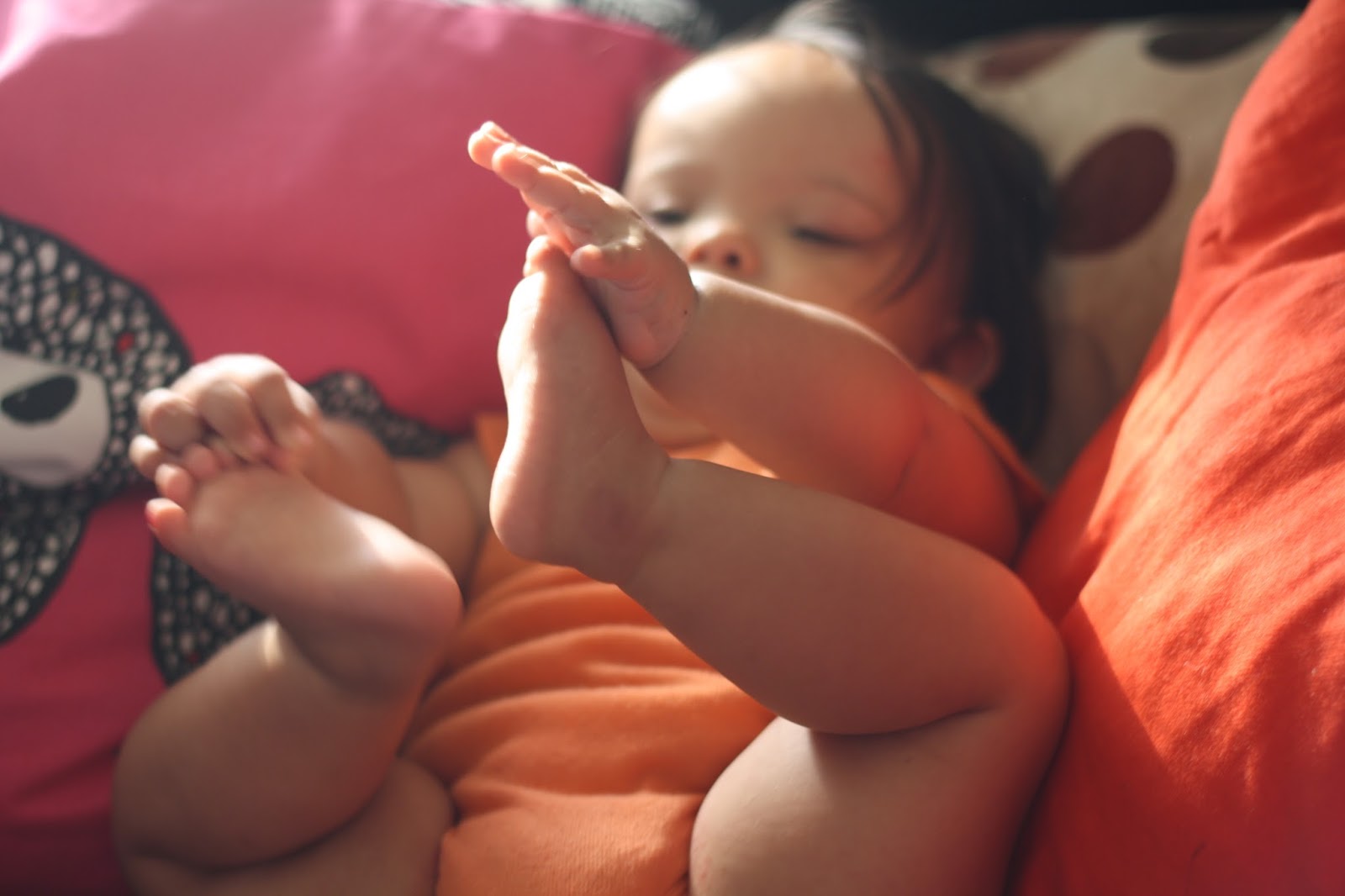
Jude loves to play more so than any of the other beasties. She loves her toes but she loves toys too. She has favorites: her balls, a stuffed panda, her little piano. She also likes to play with us. Her brother and sisters are endless sources of entertainment. I like how she engages with them, and how they engage with her. She is so much a part of our lives and the ways she plays with us demonstrates her connection to us. How she is so much a part of us now.

Now at nine months, I am stunned at how I even worried that she would be so different than us. It's funny how we can embrace difference in so many ways but then we act so scared of other differences. Our ignorance betrays us perhaps but really it's no excuse. Because here we are nine months later with this amazing, complex budding human being bursting into midst. And I no longer cry into her which I did for a long time after she was born. I cried not because I was sad but because I felt so awful for the stupid things I believed about what it would mean to have a child with Down syndrome. What becomes clear is that Jude is blossoming into someone amazing just like my other kids: at the same rate, the same pace, but in her own different way. They all had their unique perspectives to bring and Jude is not exception. But the process remains the same.


Wednesday, September 11, 2013
Drawing No Lines
We are three women sitting on the ground, dirty cement, under the roof of the picnic area. The heat is oppressive but there is a cross breeze that drifts through the open sides. In the middle of our little circle, sit three babies, all girls, all nearly the same age. December babies. Jude is thrilled at these little people in front of her. She stares at them intensely her little head nodding up and down in her effort to concentrate. When one reaches out to pull her hair, she is not so thrilled but really who could resist such a copious amount of hair?
As we chat, I give Jude her chewy necklace. Jude plays with it and naturally the aforementioned other baby can not resist the charms of such a toy. She grabs it, and starts a game of tug of war. Jude is not having it, and she pulls hard, determined to not let the baby have her treasure. The other baby manages to pull the necklace from Jude. Jude lunges forward, growling! She is not giving up her toy without a fight. And it's classic Jude. Nothing phases her. When she wants something, she's going to do whatever it takes to get that something.
I remember when Jude was smaller people telling me that it would be hard to see "typical" babies doing what Jude was not doing. These ideas are planted whether you want them or not and when we first began to hang out at the park again I found myself comparing Jude to these other two babies. One baby was starting to crawl and climb. She scurried over her mom onto my lap for a closer look at Jude who just sat there. And I felt bad. As we made the long drive home, I told H how hard it was to see the baby doing stuff Jude wasn't. H gave me that look. The look that says "Really woman come to your senses now." And I did. Jude's development is just a mute point in our world because we're too busy with Jude to care about charts or comparisons. None of our kids followed a tidy chart, and it's pretty silly to expect that with number five.
Now as I watch Jude fighting for her bead necklace, I realize that not just for us but for these babies and their moms, Jude is just a baby. We are three moms who have babies that we are hoping will get to grow up a bit together. They will be each other's play companions at these park days. Jude is really just one of the gang. They are all different. Different stages, different skills, different individuals come together for some baby fun. (And a little danger evident in the stealing of the teething necklace).
The moment stayed with me as we drove home, and throughout the evening. I kept smiling as I remembered Jude fighting for her little necklace. What hit me later as I thought back to this moment was how incredibly normal it was. It was just three babies having a good time together. Exploring the world where other little people existed. There was no lines that said "This one baby here is intellectually disabled." "This baby here is Hispanic and African-American." "This baby has allergies." There were instead intersections between all these babies that made them alike. And here in this time Jude was quite simply Jude. And this is how life has become for us. Even with therapies and some extra doctors appointments, we are just living in the being of us. Jude is no different than any of the other beasties as we adapt our flow to include her stream with ours.
I no longer think about Jude having Down syndrome all the time. There are days that float by when I don't even think the words "Down syndrome". It's such a minor part, frankly, of who this baby is to us. There was a time when I didn't think I would ever feel this way. I was consumed with thinking about what Jude having Down syndrome would mean in our lives. Before she was born, I worried that it would destroy our lives. I imagined our whole family as dredges to her disability. Then right before she was born and when I held her, I swung to the other side. She was MORE amazing than any other baby. She was a miracle. A gift. More than even the other children. We would become better people under her tutelage. She would show us how to love purely. And then, thankfully, we swung back to a place where Jude is just a human who like us all will have her own challenges and her own strengths throughout her life. But Down syndrome has merely become one small piece in this person known as Jude. Instead we have come to know this tiny person named Jude who is everyday becoming.
Monday, September 02, 2013
Baking Bread
Today, I hauled out the bread maker for the first time in many months. I had not been able to find our favorite sandwich rolls at Trader Joe's so this necessitated me making bread once again. It's not a hard process but it's a long process and time is something that I've been parceling out in tiny increments for too many projects. Bread making was lost to writing, knitting, blogging, homeschooling...and if I'm fully honest, to Facebook, the great time waster. But today it was time to start again, we needed some rolls and I could make them.
Once the dough was mixed, I dump the sticky mass onto a floured cutting board, and began to rip off hunks to set on the pan. I am not a fan of sticky textures but the feel of dough is different. Combined with the smell of yeast and flour, the texture is comforting and warm. I carefully roll each piece into a flat bun and lay it with a firm pat onto the waiting cookie sheet. When there are ten rounded rolls, I take the new soft blue dish cloth from Ikea and cover the bread. The covering is never mentioned in any of my recipes but I remember my mom always covering the rolls when I was little so I cover them.
The next few minutes is spent cleaning up the kitchen. The rolls need a long time to rise, Jude is napping peacefully, and I use the time to wash the dishes, sweep the floor. As I reach for another plate, I see the bread swelling up under the dish cloth, tiny hills pushing their way toward the ceiling. The kitchen still smells like yeast from the mixing process, and I am back to being small. In one of the various kitchens we inhabited during my young years. It doesn't matter which one because the scene is always the same. I can smell the yeast from where I am playing, and I follow the smell, recognizing that not only will be bread soon but that we are likely going someplace fun to eat said bread. I go into the kitchen, to see my mom with flour all over hands, punching bread down and kneading it with her fists. I watch as she begins to shape rolls, and I sidled up closer and closer until I can feel the warmth of her body against my side. Quickly, I reach out and grab a piece of dough. My mom looks down and smiles as I back away with my stolen treasure. I roll the dough between likely very dirty hands, loving the way it feels so warm and the way the smell increases as I make a tiny ball. Sometimes I am content to just play, other times I pop into my mouth and relish the raw yeasty taste that is only a hint of the taste of fresh baked bread.
And then I am back in my own kitchen with a dirty plate in my hand. Touched to the past through a rising up.
Saturday, August 31, 2013
We're All Fine
Friday night. Camille is lying on our bed alternating between high pitched baby talk to Jude and excited too fast words about Minecraft to H and I. As usual, Camille is waking up just as the rest of us are going to sleep. I had been talking to H about why "the post formerly known as do we diagnosis Camille or not" was such a failure. Turning to Camille, who has paused for a second to snuggle into Jude's belly, I ask "Do you want to go to a Dr. to see if you have Asperger's?"
It's a moment because for all of my talk about allowing our children to be movers in their education, etc, I'd never really asked Camille how she feels about this issue. We have talked to her about Asperger's. When I picked up The Strange Incident of the Dog In the Night, Camille began to read it, and when I asked her if she felt like she acted like the boy she answered "Well yes except that I am not good at Math." (which is nto true, she's very good at Math). Lately Camille has been listening to our conversations about disabilities, and she has had her own commentary to add to the mental notebook H and I create as we think and debate through our ideas. And of course her thoughts are remarkably right on and very frequently more insightful than many of the adults I've read. But it's never come up whether or not she sees herself as having a disability, or whether or not she wishes she had a diagnosis.
For the last 8 eight years, I've struggled with whether or not we should push for a diagnosis for Camille. I have always suspected that she might have something like Autism or Asperger's (I didn't EVEN KNOW what Asperger was until she was five and I meet our friends who have a son diagnosed with Asperger's). Initially, it was a struggle to get anything because her Dr. acted like I was pushing for drugs (which I wasn't for the record) and he told us "I don't think she has Asperger's because she shook my hand and looked me in the eyes. She's just quirky and in your family that's likely going to be okay." And I let it go because it was really really hard to push for a psychological evaluation if your family Dr. didn't recommend one. I wasn't sure if I fully agreed with the Dr. because while yeah she was quirky and that was totally okay in our world there were other things that just went beyond quirky.
The tantrums, the social anxiety aka never wanting to leave the house and having meltdowns when we did, lack of social skills that were at the time rather painful for her, insomnia, OCD, texture sensitivities. These were things that were effecting her quality of life and seemed to me to be a bit beyond the quirky diagnosis handed to us.
But I doubted myself. There was a lot of talk at the time about how parents were trying to push diagnosis on their kids when their kids were just being kids. I admit that I started to worry that I was doing this...that perhaps I was hoping for some easy answer that would explain Camille to me.
Meanwhile, we just kept living. We had started to home school again which made life much easier in many ways for Camille. After a few months of trying to force Camille to make friends, I stopped. I allowed her to sit in the van and read on park days, and I didn't pressure her to meet people when she got out to walk. That helped ease the meltdowns that often accompanied us leaving the house. We already kind of unschooled which gave Camille the freedom to pursue what interested her in as much (yes yes sometimes obsessive) detail as she wished. Insomnia wasn't too big of an issue since we didn't go to school so we could sleep as long as we wanted (and since I have insomnia Camille and I are often up together). We even worked with the OCD which seems to be worst when things are making Camille anxious. We've learned to schedule a little bit more time before we leave so Camille can perform her leaving the house ritual. And when things are really bad with the OCD, I know we need to sit down and chat about what's going on to worry her.
Yes, we are a quirky household but it really does work. We all have our things. I'm ADHD so we have to accommodate for this. We have to work around Umberto's med schedule. We have Jude's therapy, and perhaps some day other issues. Piper has anxiety attacks. R is a toddler. H has his shit too. We have all just learned to flow with the things that make up who we are. There are times when it's clear we need outside help and we seek it as it comes up. But a lot of times, I feel like we've learned to deal with things by just seeing them as normal as okay. We don't think Camille needs to be any more fixed than the rest of us need to be fixed. Camille is just Camille and yeah sometimes we all roll our eyes as we are waiting in the van for her to finish washing her hands but it's NOT weird to us. It's just life.
Lately, or if I'm fully honest since we got such a clear diagnosis of Jude, I find myself rethinking if we should be getting a diagnosis for Camille. If she needs therapy or wants meds for her OCD. I feel sometimes if I state that we are dealing with multiple disabilities I'm being a poser. Because I only know for sure that two of my children have something the world calls a disability. I don't know with Camille. I have my suspicions, and since I've finally found some great blogs about Autism, I've been reading more and seeing more of what I read happening with Camille. And of course I worry that she'll be upset someday that we didn't do more.
Thus on Friday night, I am sitting across from Camille asking her, for the first time, if she wants an official diagnosis. "No. I'm fine," she says, and goes back to telling us about her Minecraft experiences. Camille doesn't see herself as having a disability but then she doesn't see her siblings as having a disability either. As she says "They're normal to me." When pushed Camille doesn't seem to making distinctions between and abled/disabled. I am not sure how to read this because while it's clear she does see difference, she doesn't seem to regard that as problematic.
For now we will keep on as we have been. Camille is happy with her life as is, and that is a good enough place for me to be in. For the last few months, I have felt conflicted about my blog being only about Down syndrome. I got caught up in watching my numbers climb and when they didn't I would feel depressed. The problem was that my numbers only climbed when I wrote about Down syndrome (and even then I wasn't going viral or anything). I was becoming known as a "Down syndrome" blog. I woke up to the yuckiness I had become a few weeks ago. I was staring to think of my family as something to sell aka what makes my blog unique? What is about us that could set my blog apart from the other blogs? Because that would drive readership right? Part of that realization came from thinking about Camille and about her diagnosis. If I was going to "sell us" I couldn't do it based on a gut feeling right? I realized quickly enough that the thought of selling us made me feel kind of ill. Up until this point I had covered my desire to feel valued (because it's always been about feeling valued not really about making money) with this idea that I was going doing something important and good in the world aka writing about disability. My insecurity strikes again. I had come to realize that I would end compromising what this blog has always been for me and for my few loyal readers. I wasn't willing to do this for fame, recognition, etc.
This blog has always been about my family, my life. It has not never been a niche blog and that's always been okay. My blog is not big, and it's not likely to get big. I'm never going to have the readership of say "The Bloggess" and that's okay (for the record, I adore her, and she is one of the few big bloggers who I feel totally deserves her fame). Like my family, this is blog just is. I write about all kinds of shit, put up pictures, rantings, musings, and often too much text for most people to read through. My blog is not a Down syndrome blog, not a Asperger's blog, not a Epilepsy blog, nor a disability blog. It's just a blog about one kick ass family doing the best we can in the world. And like Camille "It's fine." We're all fine.
Saturday, August 24, 2013
The Myth of Girl Gender Bending
Lately, I've run across a lot of articles about boys playing with gender roles usually expressed in dressing up like a princess. These actions are labeled as boys dressing like girls, and I always smile a bit as I glance over at my girls who are not lounging about in princess dresses or plastic heels. My girls have never been over the top girly dressers although Piper has an inclination towards LOUD but that's never manifested itself into fancy dresses or tiaras. I admit that when I read these articles, and used them as a viewer of my own experience, I do roll my eyes a bit. The implication that playing with female gender roles must involve a tendency towards the flashy annoys me as it seems to just reinforce other gender roles.
But this article hit a bit differently. Here's why, this is just one comment that pointed to the same thing:
Is this really true? Certainly there is no denying the violence inflicted on men who dress as women or of the bullying these boys likely experienced. I would never dream of suggesting anything different. But are girls who dress as boys really socially acceptable? Are they really left unharmed? Uncommented upon? If this was the case why do these boys express their femininity through such "girly" clothes. Why is wearing pink, feathers, shiny sequins, etc the only expression of femininity being displayed at this camp? If girls are really able to gender bend why is there such volatile and hatred launched at lesbian woman who don't "look like" a woman?
How about this quote from the article linked above:
Lately Camille has taken to dressing in Umberto's outgrown clothes. At the beginning of the summer, I began to weed out the clothes Umberto had outgrown. I had a pile of tee shirts to give away when Camille walked in to ask what I was doing. When she the giveaway pile, she asked if she could have the tee shirts.
"Sure," I said without even a second thought. After all girls get to dress like boys right? I admit I didn't pause where I might have paused if Umberto had decided he wanted to wear dresses. Pause not because I have a problem with it but because I'd automatically fear for his safety if he walked around in dresses. But I admit that I didn't think it would even be a problem for Camille. We were at a place, it seemed, where girls could be a bit edgier in how they dressed.
And then Camille got her hair cut really short.


Judith Butler suggests that "Gender is not something that one is, it is something one does, an act...a "doing" rather than a "being." I don't think that Camille has any desire to be a "man" or that she feels displaced in terms of gender. I do think that she hates to be boxed in by gender roles, and that because she likes skulls, skateboards, and darker things she is more inclined to like "boy's" clothes. Her clothing choice, I would argue, is a reflection of how her interests as opposed to a statement about her gender. I think that perhaps Camille experiences her gender as something that is fluid, and changing. I have asked her if she likes being a girl, and she just gives me one of her haughty looks as if to say "What kind of question is THAT?" She refuses the meaning of that question. When asked if she thinks she might like girls better than boys she replies "I am ONLY ten. I don't know WHO I like yet."
H and I have not set off to raise children who automatically challenge gender roles. I dressed my girls in pink and Umberto in blue. We didn't hide their sex from our friends. Nor did we cross dress them as young children. But we also never suggested to them that there were certain ways boys or girls should look. We allowed them expression in how they wanted to dress. We tried to emphasize that heterosexuality is not the only option or even the normal option in our society. We did make a conscience effort to raise human children who value compassion, love, equality, etc. And because we were both influenced by Butler as well as other great feminist thinkers, we likely imparted this idea that gender is fluid onto them without even trying.
I think we have a long ways to go before we see gender as fluid. And I think that the idea that girls can dress as boys is, frankly, grossly over exaggerated. I also tentatively wonder if we place too much expression on our children's desires to wear clothes that not fit into the gender norms. If we read too much meaning into these action, do we risk making perpetuating gender stereotypes. I wonder, often, what a world in which gender and sexuality are seen as malleable creations, would look like. What liberatory possibilities might emerge if there were not such as thing as "boy" or "girl" clothes.
But this article hit a bit differently. Here's why, this is just one comment that pointed to the same thing:
People tend to get a lot more upset seeing a boy dressing up in girl's clothing than a girl dressing in boy's clothing. Why do you think that is? Generations of social and cultural indoctrination is a good place to start. Maybe the culture doesn't care as much or have as much invested in what girls do as what boys do......
Is this really true? Certainly there is no denying the violence inflicted on men who dress as women or of the bullying these boys likely experienced. I would never dream of suggesting anything different. But are girls who dress as boys really socially acceptable? Are they really left unharmed? Uncommented upon? If this was the case why do these boys express their femininity through such "girly" clothes. Why is wearing pink, feathers, shiny sequins, etc the only expression of femininity being displayed at this camp? If girls are really able to gender bend why is there such volatile and hatred launched at lesbian woman who don't "look like" a woman?
How about this quote from the article linked above:
The couple passed a man they knew from the neighborhood who was standing with a group of other men. The men, commenting on the 23-year-old's masculine dress, shouted anti-gay slurs, calling her "dyke" and "bitch."
Lately Camille has taken to dressing in Umberto's outgrown clothes. At the beginning of the summer, I began to weed out the clothes Umberto had outgrown. I had a pile of tee shirts to give away when Camille walked in to ask what I was doing. When she the giveaway pile, she asked if she could have the tee shirts.
"Sure," I said without even a second thought. After all girls get to dress like boys right? I admit I didn't pause where I might have paused if Umberto had decided he wanted to wear dresses. Pause not because I have a problem with it but because I'd automatically fear for his safety if he walked around in dresses. But I admit that I didn't think it would even be a problem for Camille. We were at a place, it seemed, where girls could be a bit edgier in how they dressed.
And then Camille got her hair cut really short.

And suddenly I became aware of how people looked at her in public. Because not only was her hair very short but she was dressed like a boy. Not like a girl wearing clothes that were kind of boyish. You know girly tee shirt or jeans with flowers embroidered on the pockets. She was wearing actual boy clothes. And she wasn't wearing earrings or jewelry to set off that cute short hair. As we walked through grocery stores or hung out at Barnes and Nobles, I started to notice the second glances, the confused looks, the pinched mouths when people realized that Camille was indeed a girl.
It hit me quite strongly that girls are not allowed to dress like boys. It's not socially acceptable. Girls are allowed to wear things that were once considered boyish: jeans, tee shirts, even caps but these things must be remade into the image of girl. When a girl actually dons boys clothes with no subtle signs that she is a girl, it makes people uncomfortable, and I suspect it makes my sweet girl as vulnerable to bullying and violence as the boy who is wearing a dress.


Judith Butler suggests that "Gender is not something that one is, it is something one does, an act...a "doing" rather than a "being." I don't think that Camille has any desire to be a "man" or that she feels displaced in terms of gender. I do think that she hates to be boxed in by gender roles, and that because she likes skulls, skateboards, and darker things she is more inclined to like "boy's" clothes. Her clothing choice, I would argue, is a reflection of how her interests as opposed to a statement about her gender. I think that perhaps Camille experiences her gender as something that is fluid, and changing. I have asked her if she likes being a girl, and she just gives me one of her haughty looks as if to say "What kind of question is THAT?" She refuses the meaning of that question. When asked if she thinks she might like girls better than boys she replies "I am ONLY ten. I don't know WHO I like yet."
H and I have not set off to raise children who automatically challenge gender roles. I dressed my girls in pink and Umberto in blue. We didn't hide their sex from our friends. Nor did we cross dress them as young children. But we also never suggested to them that there were certain ways boys or girls should look. We allowed them expression in how they wanted to dress. We tried to emphasize that heterosexuality is not the only option or even the normal option in our society. We did make a conscience effort to raise human children who value compassion, love, equality, etc. And because we were both influenced by Butler as well as other great feminist thinkers, we likely imparted this idea that gender is fluid onto them without even trying.
I think we have a long ways to go before we see gender as fluid. And I think that the idea that girls can dress as boys is, frankly, grossly over exaggerated. I also tentatively wonder if we place too much expression on our children's desires to wear clothes that not fit into the gender norms. If we read too much meaning into these action, do we risk making perpetuating gender stereotypes. I wonder, often, what a world in which gender and sexuality are seen as malleable creations, would look like. What liberatory possibilities might emerge if there were not such as thing as "boy" or "girl" clothes.
Monday, August 19, 2013
One Plus Forty
Yes, gentle readers, it is time for the birthday post. This year I actually make it on my birthday.
I woke up this morning, and thought again to last year. Last year when I turned forty and didn't even make a post because I was still struggling with fear and hope. And this year, I woke up, to the soft rain on the roof, the delish feel of Jude. She's all hope, no fear. I didn't even open my eyes, I just held her against me, and then R curled up against my back. This morning I just let myself soak up the joy.
What a year forty was.
I've been trying so hard for so long to just let myself love life. To accept the good. To be happy. I'd often feel like I could lay my hands on letting go but then I'd allow something to derail me. Because really I was still scared to be this happy. My first thought when I found out Jude had Down syndrome was "See this is what I get for being happy." It was an incredibly stupid, ungrateful thought since I wanted Jude so very much. But I'm kind of glad I had it because once I held that baby in my arms, I knew how incredibly stupid it was in a such a way that it shattered through the last of my hard shell. Jude was our completion to our joy, to my joy. I realized that there was nothing to fear, that I could let go. Something inside me healed in those early days with Jude. I felt complete. Finally.
These days life has a new tenor. Not because Jude taught me some lesson (my children are not vessels for my growth). No it's more that because I had to go through so much garbage tossing in my own head when I was pregnant with Jude that I really emerged from that experience, transformed. Today, I laugh easier. I am more comfortable in this skin, this body. Sure I still feel down sometimes. I still explode a little more than I'd like. But I also do little things like ham it up for the camera. It's a lot easier to coax a smile from me. I've finally stopped worrying about the other shoe dropping, and I'm falling back into this life.
The last birthday post was about my struggle to write out my future. All that I had defined myself on was gone. I had not gotten into a Ph.D program and I was bitter. Unsure of what I was. My whole life had been defined as being "academically gifted." I was supposed to do "great" things. And I really thought that I had failed miserably. I spent the first year and a half in Athens, deeply depressed and somewhat lost. I was trying to be happy. To re imagine my life.
Today, I am happy with where I am. With what many would see as an average life. It's a good life. A beautiful life. Filled with joy. Beauty. Love. Laughing. I wouldn't trade this life for a Ph.D. I still don't know where I am going to go with my life. But it's okay. I am happy writing here to my small audience. I am content with working on my short story collection, quietly. I don't even fantasy too often about publishing those stories. I'm thinking about learning to quilt which is something I've wanted to do since I was in my early 20s. I'm playing with my knitting more, branching out. Same with the photography, and taking a cue from my kids it has more to do with love then with career or fame. This is a new feeling. A good feeling.
My birthday was simple. Waking up surrounded by the softness of my babies. A lovely homemade card from H, and then a surprise of flowers. All after a wonderful weekend with my mom. A night out with my husband complete with a surprise punk show at the Common Market. I made fried green tomatoes for the first time. We ate more cake. And now I am here, writing in one my favorite places. Surrounded and buoyed by so many birthday wishes. My life is average and not average. It is average perhaps in the way we too often define success but it is extraordinary in the love that surrounds me from so many places. Thank you all for making this old girl feel so special.
Friday, August 16, 2013
Fruits of Labor and Stuff
Umberto turned 13this summer. We pulled him out of school for the final time when he was nine. He still wasn't reading much, and he seemed to be so far behind academically that he would never catch up. But he was also unhappy in school. He wasn't catching up either. I was told by a couple of teachers that his problem was simply that he had a low IQ and that my desire to make it something else was wishful thinking. And I just realized that if I left him in school that he was going to be ground down and destroyed. We pulled him because, really, we had come to realize, this shit just didn't matter.
"Why prepare our kids to hate life?" H said as we lay there one night discussing what we should do.
And for the most part, I was able to let go of the fear of him "succeeding." When I started to feel scared, or worried, I remembered swimming. How they all learned to swim by playing in the pool summer after summer. By watching their father who is an excellent swimmer. I remembered sitting under the darkening sky, as the pool lights flashed on, sending ripples of light over the water, as their smooth bodies dove again and again beneath the shining water. How they swam with such confidence and such grace. They had not needed lessons. Yes they lacked precision, and professional polish. But they didn't want to win a race, or prove anything to anyone. They swam because quite simply they loved to swim.
[Later on, this holding of memory would serve me as I struggled with not being accepted into a Ph.D program. I would remember that perhaps we should do things for love not for fame, not for recognition, not to get ahead, not to get a job. That, though, is another story for another time.]
A couple of years ago, H and I did start to have conversations with Umberto about his future. His goal at 11 was to work at Gamestop. A dream job to a boy who loves his Xbox. I admit to trying to push a little towards game design or some such career. But he was resistant to that direction of conversation. A few times he said "Yeah I'd like that...I'd like to go to college" but when we tried to work with him on college prep material, he was not interested. We would fight. Frustration would set in, and I would remember the swimming. I would remember how we once tried to pressure him into being on a swim team and how for a time his love dimmed. So I backed away.
This summer we assured Umberto that we would respect any decision that he made with his life. I had been doing a lot of re [thinking] about success, intelligence, etc. I had to reevaluate my own priorities and expectations. So much of my insecurity derives from never feeling like I'm good enough. There has been too much sadness over the things I thought people expected me to do and too little joy over what I already had achieved. I realized at some point, that I often did things not because I love them but because I thought that these were the things expected from me.
And Umberto announced to me one day, "I want to go to college." And he didn't let it go. He made it clear that he wasn't sure what he wanted to do in college but that he could see that as a goal someday. We talked about some different curriculums, and books to read. Umberto loves history and science. He started talking about writing game ideas down, and he loved how he could work history into those ideas. He wants to work on writing fiction--something I never expected from him.
Each morning he gets up, and he's ready to work. He's getting things now that he didn't get last year, and things that left us both in tears, he sails through. Today he was reading to me some interesting (aka gross things) he had learned about cells, and said "I'll have no problem writing about the interesting things today." And I said "You know Umberto whenever you find something really interesting we can put this other stuff on hold while you pursue it." He looked at me and smiled "I know."

Monday, August 05, 2013
The Burden of Goodness
“I hate to hear you talk about all women as if they were fine ladies instead of rational creatures. None of us want to be in calm waters all our lives.”I used to call Piper my sweet beastie. After all Piper was the one who smiled at everyone. She loved to cuddle and hug. Piper was the one who could be counted on to share, to be kind, etc. I never stopped to think about the consequences of labeling her because these qualities were after all wonderful. Societal approved. Especially for a girl. Despite all my theory, all my feminist thinking, I got caught up on approving these things in Piper.
― Jane Austen, Persuasion
And then Piper started exploding.
It started with preschool. We enrolled her in a little alternative preschool near our house. She was acting lonely and depressed since we were attempting another year of school for the older two beasties (that failed as well but that's another story). I thought maybe being around some other kids would be good as Piper seemed pretty outgoing and friendly. "She was an 'extrovert'," I thought and she needed other people. But at school, she was sullen. She would angrily refuse to talk to other kids. We were shocked and dismayed. This wasn't Piper at all! We started to worry that there was something "wrong."
But was there really anything wrong? Is it wrong to not want to be friendly all the time? Maybe it was the other kids and not Piper. We realized after some conversations with Piper that she was being ostracized by the other kids. In fact, there was one girl who seemed to be actively building a case against Piper because Piper wouldn't be bossed around.
The explosions continued at home. Piper displayed a ferocious temper when shit pissed her off. She was impatience and ornery. She was bitchy and crabby. But she was also sweet and loving. She was the first one to hug you when you were sad just as she might be the first to explode at Rowena who was having yet another tantrum.
You see, it's simple, Piper is human. She is a constantly becoming person. Morphing and changing daily. She like all humans displays a full range of emotions. And I suspect that being boxed so openly by me, and others, created a perfect storm of frustration. She had to kick out and stretch her wings, let us know that she was more than a sweet girl. She was also a fierce girl. An angry girl. A girl who knew what she wanted. This doesn't mean she got to express these things however she choose to. But it did mean that she was allowed to challenge the definitions set on her. We had to open the possibilities of what it meant to be Piper.
As a female, I believe it is vitally important to encourage my girl beasties in the complexity of becoming that is all to often only given to white, middle class males (and yes sometimes females but not as strongly or as often). I don't want Piper to be the sweet little girl all the time. That's narrowing and limiting. It crushes other emotions that have value and importance. A little outrage is a good thing when protesting injustice. Just like a righteous anger over discrimination can take one a long way towards the betterment of the world.
This has become something of an important idea for me now that Jude has come along. I've been recently engaged in conversation about positive stereotypes, and I've attempted to argue why they are problematic for me. What is wrong with people with Ds as being seen as kind, empathic, loving? Well nothing if it's acknowledged that they are also not always these things. I don't want Jude pushed into any kind of box. It seems that the world sees her as either not worthy of life or as a perfect angel sent from God to spread love and light. Where is the room to be human in those extremes?
“Once you label me you negate me.”We seem to hold onto the positive stereotypes as a way to counter the really awful shit out there. And just go read the comments on articles about Ds if you want to see some of that darkness. However, I am not convinced that turning to a glorification of what we see as Ds is really valuable either. It denies people the ability to be fully human, fully complicated, fully able to fuck up, fully able to be angry. Jude deserves to be a complex human being. She deserves to have someone snap at her in frustration, "I don't get you."
― Søren Kierkegaard
Because the thing is these stereotypes are just as denying of the humanity of my child as the negative stereotypes. Frankly, they're also just as dangerous. We see what happens when people of color, or women or gay people don't act like the positive stereotypes. They are killed. Yeah, I know it sounds dramatic but think about it for a few minutes. Trayvon Martin was wearing a hoodie. He had smoked pot. There was a picture of him flipping off a camera and sadly to many people this was good reason for Zimmeran to kill him. Yet, I've done all those things and no one has proposed I shouldn't do them in order to be safe. Ethan Saylor wasn't acting like a sweet little angel when he was at the theater and he ended up on the floor, dying. Antonio Martinez was wearing a hoodie, hiding his face, trying to escape what he saw as a threat. He wasn't smiling, hugging someone, being the chromosome of love. He was beaten with a police baton. What about our adult children who are raped, abused, starved to death? Where they acting like a stereotype? And if not did this give people the right to see them as not worthy of life? It's worth considering.
“I think fitting in is highly overrated. I’d rather just fit out... Fitting out means being who you are, even when people insist that you have to change. Fitting out means taking up space, not apologizing for yourself, and not agreeing with those who seek to label you with stereotypes.”I think that the point of all stereotypes is to place people into categories. And categories are too often limiting and confining. As someone who has been categorized: white trash, high IQ, ADHD, female, fat, I have felt to some extent the sting and limitations of such things. I have struggled much of my life to be unafraid of my voice, and of my own emotions, thoughts, etc. I have known the sting of rejection because I was an "angry fat woman" when the expected was to be jolly and complacent. I have been told often that I am too angry. Too angry according to who or what? I am guessing the categories that suggest that anger is bad because I am a woman. Stereotypes are designed to keep us in our place and how that can be seen as positive I do not know.
― Golda Poretsky
In addition, stereotypes of all kinds enforce an idea that we are "essentially different" by suggesting that some of us as a group are biologically different. While I am a big fan of being different, of fitting out, the problem is that we narrow difference to a range of characteristics that can be linked to biology, we open up the conversation for an inclusion of negative stereotypes as well. We suggest that the difference which might exist between all individuals is a difference that is really about groups of people. If you don't question the danger of this take a look at Nazi Germany. There are many research articles about this. Here and here for example.
What it boils down for me is that I want Jude and all my children to be able to take up space as humans not as categories. I want them to not feel limited by the negative or positive stereotypes out there. They deserve like we all deserve to be able to experience a full spectrum of humanness. Jude doesn't need magical thinking to be a human deserving of life and love. She shouldn't have to ever worry about her safety if she doesn't act like a stereotype. She should not be limited because someone has decided she has a biological difference that limits her expression. The difference that I want for Jude is a difference that comes from breaking out not from being reined in.
Subscribe to:
Posts (Atom)
