Saturday, September 28, 2013

Why We Do What We Do

I have already written about how Umberto decided he wanted to do more schooling because he wants to prepare for college. And so far things have been going smoothly. We have not had the struggles we had last year. When I ask Umberto to work, he comes to the table willingly. I have also learned to not be so rigid. If Umberto wants to have a friend over, or if he just bought a Xbox game (cough GTA V cough) then we just rearrange things. Sometimes social studies sucks up more time than I had planned so we don't have time for writing. We just roll with it. Letting go of the stress of having to get things done opens up a whole new atmosphere to schooling for all of us. Things are less angry, less hurried. When plans fall through I don't feel the intense stress of having to get it done. We have time. All the time we need. Because really if we don't finish Math lesson 23 today, the world will keep spinning. Before, I would rush, rage, and end up just giving up.

Now I can see that it was a combination of things. My attitude. Umberto not being ready. So here we are now in just the right spot. And it's not been totally easy. My house is a mess. I feel like the other kids are getting a bit neglected. Umberto needs me to right beside him for most of his work. We're working on independence, and I know it will come, but right now it's a bit confining. The positive in this side by side work is that Umberto and I have become very close. I think it's often the case that a child reaches their teen years, they drift away. It's nice to not find that happening; to have the opposite occurring as we work together.  We can get creative about where school happens as well. So sometimes we do our work on the floor while Jude plays, giving us a few minutes to be together between baby care.


In addition, to our closeness, I've watched Umberto develop new interests. He has ended up really loving history which surprised, I think, us both. And he has learned to take pride in things. The other day he yelled "Yes, a 100 on that the Math quiz!" and it came from him not because we grade or because we even emphasis that kind of accomplishment. But for a kid who often struggles with academic self worth it was a pretty awesome moment. Maybe because it came from his own sense of accomplishment as opposed to pressure from others.


But I think the neatest moment came when Umberto had to build a diorama on a habitat of his choice. He was pretty blah about it, and it kept getting pushed to the back burner by both of us. I knew it was going to take a lot of effort on my part to get him started and since he was not feeling it, it would likely lead to conflict. I thought about just skipping the assignment. I've always though dioramas were kind of boring, and a waste of time anyway. Memories of horribly failed projects from my own child were foremost in my mind. I always had grand ideas that never quite coalesced into reality. 

Still it was his first science project and I thought it would be good to just bull through and do it. We could mark it as done and then decide if it was something worth doing again. So last Sunday night, I found a shoe box, and said "Let's do it." What happened was pretty awesome. Piper and Camille were instantly interested when I brought out the air dry clay. I explained to them Umberto's assignment, and they both wanted to help. Soon we were all sitting on the floor in the living room, the Ipad propped up in front of us with images of coral reefs before us, surrounded by National Geographic magazines and clay. Piper was making sea turtles, and Camille started in on shark. Umberto was looking through the magazines, and talking about making a clown fish. Then we downloaded some coloring sheets, everyone peeking over my shoulders as we scrolled through pages of options. There was coloring, cutting, and discussion.

On Wednesday when the clay was dry so we started to assemble the diorama. At first it was just Umberto and I. Camille came out and wanted to be involved. I stepped back and let them go to town. They came up with creative ways to get the big things in the front, and the smaller things in the back. Umberto used H's wedge idea to have the fish appear to be standing. He also came up with the idea of how to hang the seahorse. Camille made Popsicle stick props to keep the coral upright. 

In the end, we had a group effort. A family created project that arose from something that I was dreading. And it's what I really love about homeshooling. The improvisation. The unexpected fun and joy. 


Monday, September 16, 2013

Months of Joy

There has been a lot of frankly, bad shit, in the news lately. Stories that would have broken my heart before Jude hurt even more so now. And while I weep, I'm also angry. Angry at the unfairness of life. Angry at how the media represents people with disabilities. Angry at how we keep coming up with excuses for why parents kill or attempt to kill their disabled children. Why our kids aren't worthy of heart transplants. It just falls down on me sometimes especially late at night when I can not sleep. I feel the weight of so much pain, so much horror. Our children are worthy, I yell again and again.

But today, I want to write about joy. Joy over nine months of love, joy, average life, and the settling in of another beastie into our family. Nine months ago today, Jude came to us through a fast labor that did take me a bit by surprise. I remember that evening still, a little shell shocked, tentative with this new person who I thought might be so different from me, from the rest of us. I held her long into the night, and fell in love with every bit of her. I cried into her hair, and promised that I'd love her forever. I can still feel the weight of her against me, and the smell of her soft hair will always be with me.

And the love affair continues. 9 months old is a magical age. 9 months in the womb and nine months out. There is a tentative quality to babies, for me at least. I don't really know who they are, and while children are always becoming as we all are, there are some traces to who they are at this tender age. At nine months, I see less of just the baby and more of them. It's been that way with all of my beasties, and it is this way with Jude.

Jude has an amazing personality. She is so complex, and rich. I feel that it will take a life time to know her. The mystery of being is strong when you have children. You always feel that you will run out of time before you know them, and you will because they are always morphing. Reaching new places. Jude is starting this amazing journey. Already I see glimmers of what will shape her.

She is fierce.

Jude growls at us if she's feeling like we're intruding on her space or cramping her style. She doesn't like to have help forced on her, and wants to do things on her own.  


She puts up with my antics, with being my model but she's not docile about it. She'll grunt, makes faces me, basically make it clear that she won't tolerate much more. She's no fool, this little girl, and she's not biddable. A highly desirable quality in any girl.


Jude is sly with her humor. You have to work to get a smile from this girl. But she's goofy on her own terms. She'll make a face, give you a sly grin, invite you to play a little game with her. She is not someone who is always happy though. Jude is not a stereotype, and her humor is so subtle you might miss her. 


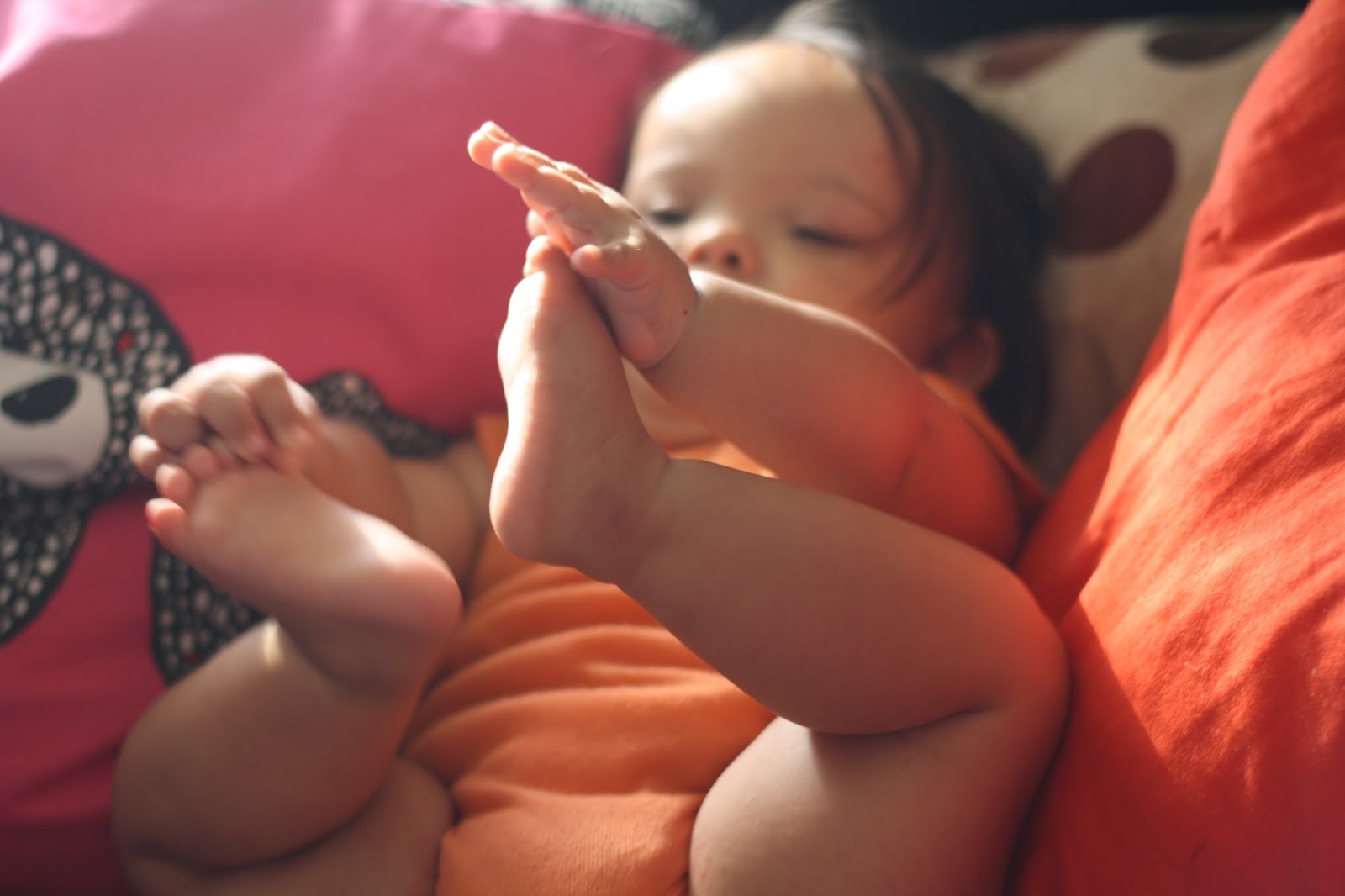
Jude loves to play more so than any of the other beasties. She loves her toes but she loves toys too. She has favorites: her balls, a stuffed panda, her little piano. She also likes to play with us. Her brother and sisters are endless sources of entertainment. I like how she engages with them, and how they engage with her. She is so much a part of our lives and the ways she plays with us demonstrates her connection to us. How she is so much a part of us now.


Now at nine months, I am stunned at how I even worried that she would be so different than us. It's funny how we can embrace difference in so many ways but then we act so scared of other differences. Our ignorance betrays us perhaps but really it's no excuse. Because here we are nine months later with this amazing, complex budding human being bursting into midst. And I no longer cry into her which I did for a long time after she was born. I cried not because I was sad but because I felt so awful for the stupid things I believed about what it would mean to have a child with Down syndrome. What becomes clear is that Jude is blossoming into someone amazing just like my other kids: at the same rate, the same pace, but in her own different way. They all had their unique perspectives to bring and Jude is not exception. But the process remains the same. 


Wednesday, September 11, 2013

Drawing No Lines

We are three women sitting on the ground, dirty cement, under the roof of the picnic area. The heat is oppressive but there is a cross breeze that drifts through the open sides. In the middle of our little circle, sit three babies, all girls, all nearly the same age. December babies. Jude is thrilled at these little people in front of her. She stares at them intensely her little head nodding up and down in her effort to concentrate. When one reaches out to pull her hair, she is not so thrilled but really who could resist such a copious amount of hair?

As we chat, I give Jude her chewy necklace. Jude plays with it and naturally the aforementioned other baby can not resist the charms of such a toy. She grabs it, and starts a game of tug of war. Jude is not having it, and she pulls hard, determined to not let the baby have her treasure. The other baby manages to pull the necklace from Jude. Jude lunges forward, growling! She is not giving up her toy without a fight. And it's classic Jude. Nothing phases her. When she wants something, she's going to do whatever it takes to get that something.

I remember when Jude was smaller people telling me that it would be hard to see "typical" babies doing what Jude was not doing. These ideas are planted whether you want them or not and when we first began to hang out at the park again I found myself comparing Jude to these other two babies. One baby was starting to crawl and climb. She scurried over her mom onto my lap for a closer look at Jude who just sat there. And I felt bad. As we made the long drive home, I told H how hard it was to see the baby doing stuff Jude wasn't. H gave me that look. The look that says "Really woman come to your senses now." And I did. Jude's development is just a mute point in our world because we're too busy with Jude to care about charts or comparisons. None of our kids followed a tidy chart, and it's pretty silly to expect that with number five.

Now as I watch Jude fighting for her bead necklace, I realize that not just for us but for these babies and their moms, Jude is just a baby. We are three moms who have babies that we are hoping will get to grow up a bit together. They will be each other's play companions at these park days. Jude is really just one of the gang. They are all different. Different stages, different skills, different individuals come together for some baby fun. (And a little danger evident in the stealing of the teething necklace).

The moment stayed with me as we drove home, and throughout the evening. I kept smiling as I remembered Jude fighting for her little necklace. What hit me later as I thought back to this moment was how incredibly normal it was. It was just three babies having a good time together. Exploring the world where other little people existed. There was no lines that said "This one baby here is intellectually disabled." "This baby here is Hispanic and African-American." "This baby has allergies." There were instead intersections between all these babies that made them alike. And here in this time Jude was quite simply Jude. And this is how life has become for us. Even with therapies and some extra doctors appointments, we are just living in the being of us. Jude is no different than any of the other beasties as we adapt our flow to include her stream with ours.

I no longer think about Jude having Down syndrome all the time. There are days that float by when I don't even think the words "Down syndrome". It's such a minor part, frankly, of who this baby is to us. There was a time when I didn't think I would ever feel this way. I was consumed with thinking about what Jude having Down syndrome would mean in our lives. Before she was born, I worried that it would destroy our lives. I imagined our whole family as dredges to her disability. Then right before she was born and when I held her, I swung to the other side. She was MORE amazing than any other baby. She was a miracle. A gift. More than even the other children. We would become better people under her tutelage. She would show us how to love purely. And then, thankfully, we swung back to a place where Jude is just a human who like us all will have her own challenges and her own strengths throughout her life. But Down syndrome has merely become one small piece in this person known as Jude. Instead we have come to know this tiny person named Jude who is everyday becoming.


Monday, September 02, 2013

Baking Bread

Today, I hauled out the bread maker for the first time in many months. I had not been able to find our favorite sandwich rolls at Trader Joe's so this necessitated me making bread once again. It's not a hard process but it's a long process and time is something that I've been parceling out in tiny increments for too many projects. Bread making was lost to writing, knitting, blogging, homeschooling...and if I'm fully honest, to Facebook, the great time waster. But today it was time to start again, we needed some rolls and I could make them.

Once the dough was mixed, I dump the sticky mass onto a floured cutting board, and began to rip off hunks to set on the pan. I am not a fan of sticky textures but the feel of dough is different. Combined with the smell of yeast and flour, the texture is comforting and warm. I carefully roll each piece into a flat bun and lay it with a firm pat onto the waiting cookie sheet. When there are ten rounded rolls, I take the new soft blue dish cloth from Ikea and cover the bread. The covering is never mentioned in any of my recipes but I remember my mom always covering the rolls when I was little so I cover them.

The next few minutes is spent cleaning up the kitchen. The rolls need a long time to rise, Jude is napping peacefully, and I use the time to wash the dishes, sweep the floor. As I reach for another plate, I see the bread swelling up under the dish cloth, tiny hills pushing their way toward the ceiling. The kitchen still smells like yeast from the mixing process, and I am back to being small. In one of the various kitchens we inhabited during my young years. It doesn't matter which one because the scene is always the same. I can smell the yeast from where I am playing, and I follow the smell, recognizing that not only will be bread soon but that we are likely going someplace fun to eat said bread. I go into the kitchen, to see my mom with flour all over hands, punching bread down and kneading it with her fists. I watch as she begins to shape rolls, and I sidled up closer and closer until I can feel the warmth of her body against my side. Quickly, I reach out and grab a piece of dough. My mom looks down and smiles as I back away with my stolen treasure. I roll the dough between likely very dirty hands, loving the way it feels so warm and the way the smell increases as I make a tiny ball. Sometimes I am content to just play, other times I pop into my mouth and relish the raw yeasty taste that is only a hint of the taste of fresh baked bread.

And then I am back in my own kitchen with a dirty plate in my hand. Touched to the past through a rising up.

Saturday, August 31, 2013

We're All Fine

Friday night. Camille is lying on our bed alternating between high pitched baby talk to Jude and excited too fast words about Minecraft to H and I. As usual, Camille is waking up just as the rest of us are going to sleep. I had been talking to H about why "the post formerly known as do we diagnosis Camille or not" was such a failure. Turning to Camille, who has paused for a second to snuggle into Jude's belly, I ask "Do you want to go to a Dr. to see if you have Asperger's?"

It's a moment because for all of my talk about allowing our children to be movers in their education, etc, I'd never really asked Camille how she feels about this issue. We have talked to her about Asperger's. When I picked up The Strange Incident of the Dog In the Night, Camille began to read it, and when I asked her if she felt like she acted like the boy she answered "Well yes except that I am not good at Math." (which is nto true, she's very good at Math). Lately Camille has been listening to our conversations about disabilities, and she has had her own commentary to add to the mental notebook H and I create as we think and debate through our ideas. And of course her thoughts are remarkably right on and very frequently more insightful than many of the adults I've read. But it's never come up whether or not she sees herself as having a disability, or whether or not she wishes she had a diagnosis. 

For the last 8 eight years, I've struggled with whether or not we should push for a diagnosis for Camille. I have always suspected that she might have something like Autism or Asperger's (I didn't EVEN KNOW what Asperger was until she was five and I meet our friends who have a son diagnosed with Asperger's). Initially, it was a struggle to get anything because her Dr. acted like I was pushing for drugs (which I wasn't for the record) and he told us "I don't think she has Asperger's because she shook my hand and looked me in the eyes. She's just quirky and in your family that's likely going to be okay." And I let it go because it was really really hard to push for a psychological evaluation if your family Dr. didn't recommend one. I wasn't sure if I fully agreed with the Dr. because while yeah she was quirky and that was totally okay in our world there were other things that just went beyond quirky. 

The tantrums, the social anxiety aka never wanting to leave the house and having meltdowns when we did, lack of social skills that were at the time rather painful for her, insomnia, OCD, texture sensitivities. These were things that were effecting her quality of life and seemed to me to be a bit beyond the quirky diagnosis handed to us.

But I doubted myself. There was a lot of talk at the time about how parents were trying to push diagnosis on their kids when their kids were just being kids. I admit that I started to worry that I was doing this...that perhaps I was hoping for some easy answer that would explain Camille to me. 

Meanwhile, we just kept living. We had started to home school again which made life much easier in many ways for Camille. After a few months of trying to force Camille to make friends, I stopped. I allowed her to sit in the van and read on park days, and I didn't pressure her to meet people when she got out to walk. That helped ease the meltdowns that often accompanied us leaving the house. We already kind of unschooled which gave Camille the freedom to pursue what interested her in as much (yes yes sometimes obsessive) detail as she wished. Insomnia wasn't too big of an issue since we didn't go to school so we could sleep as long as we wanted (and since I have insomnia Camille and I are often up together). We even worked with the OCD which seems to be worst when things are making Camille anxious. We've learned to schedule a little bit more time before we leave so Camille can perform her leaving the house ritual. And when things are really bad with the OCD, I know we need to sit down and chat about what's going on to worry her.

Yes, we are a quirky household but it really does work. We all have our things. I'm ADHD so we have to accommodate for this. We have to work around Umberto's med schedule. We have Jude's therapy, and perhaps some day other issues. Piper has anxiety attacks. R is a toddler. H has his shit too. We have all just learned to flow with the things that make up who we are. There are times when it's clear we need outside help and we seek it as it comes up. But a lot of times, I feel like we've learned to deal with things by just seeing them as normal as okay. We don't think Camille needs to be any more fixed than the rest of us need to be fixed. Camille is just Camille and yeah sometimes we all roll our eyes as we are waiting in the van for her to finish washing her hands but it's NOT weird to us. It's just life.

Lately, or if I'm fully honest since we got such a clear diagnosis of Jude, I find myself rethinking if we should be getting a diagnosis for Camille. If she needs therapy or wants meds for her OCD. I feel sometimes if I state that we are dealing with multiple disabilities I'm being a poser. Because I only know for sure that two of my children have something the world calls a disability. I don't know with Camille. I have my suspicions, and since I've finally found some great blogs about Autism, I've been reading more and seeing more of what I read happening with Camille. And of course I worry that she'll be upset someday that we didn't do more.

Thus on Friday night, I am sitting across from Camille asking her, for the first time, if she wants an official diagnosis. "No. I'm fine," she says, and goes back to telling us about her Minecraft experiences. Camille doesn't see herself as having a disability but then she doesn't see her siblings as having a disability either. As she says "They're normal to me." When pushed Camille doesn't seem to making distinctions between and abled/disabled. I am not sure how to read this because while it's clear she does see difference, she doesn't seem to regard that as problematic.

For now we will keep on as we have been. Camille is happy with her life as is, and that is a good enough place for me to be in. For the last few months, I have felt conflicted about  my blog being only about Down syndrome. I got caught up in watching my numbers climb and when they didn't I would feel depressed. The problem was that my numbers only climbed when I wrote about Down syndrome (and even then I wasn't going viral or anything). I was becoming known as a "Down syndrome" blog. I woke up to the yuckiness I had become a few weeks ago. I was staring to think of my family as something to sell aka what makes my blog unique? What is about us that could set my blog apart from the other blogs? Because that would drive readership right? Part of that realization came from thinking about Camille and about her diagnosis. If I was going to "sell us" I couldn't do it based on a gut feeling right? I realized quickly enough that the thought of selling us made me feel kind of ill. Up until this point I had covered my desire to feel valued (because it's always been about feeling valued not really about making money) with this idea that I was going doing something important and good in the world aka writing about disability. My insecurity strikes again. I had come to realize that I would end compromising what this blog has always been for me and for my few loyal readers. I wasn't willing to do this for fame, recognition, etc.

This blog has always been about my family, my life. It has not never been a niche blog and that's always been okay. My blog is not big, and it's not likely to get big. I'm never going to have the readership of say "The Bloggess" and that's okay (for the record, I adore her, and she is one of the few big bloggers who I feel totally deserves her fame). Like my family, this is blog just is. I write about all kinds of shit, put up pictures, rantings, musings, and often too much text for most people to read through. My blog is not a Down syndrome blog, not a Asperger's blog, not a Epilepsy blog, nor a disability blog. It's just a blog about one kick ass family doing the best we can in the world. And like Camille "It's fine." We're all fine. 

Saturday, August 24, 2013

The Myth of Girl Gender Bending

Lately, I've run across a lot of articles about boys playing with gender roles usually expressed in dressing up like a princess. These actions are labeled as boys dressing like girls, and I always smile a bit as I glance over at my girls who are not lounging about in princess dresses or plastic heels. My girls have never been over the top girly dressers although Piper has an inclination towards LOUD but that's never manifested itself into fancy dresses or tiaras. I admit that when I read these articles, and used them as a viewer of my own experience, I do roll my eyes a bit. The implication that playing with female gender roles must involve a tendency towards the flashy annoys me as it seems to just reinforce other gender roles.

But this article hit a bit differently. Here's why, this is just one comment that pointed to the same thing:

People tend to get a lot more upset seeing a boy dressing up in girl's clothing than a girl dressing in boy's clothing. Why do you think that is? Generations of social and cultural indoctrination is a good place to start. Maybe the culture doesn't care as much or have as much invested in what girls do as what boys do......

Is this really true? Certainly there is no denying the violence inflicted on men who dress as women or of the bullying these boys likely experienced. I would never dream of suggesting anything different. But are girls who dress as boys really socially acceptable? Are they really left unharmed? Uncommented upon? If this was the case why do these boys express their femininity through such "girly" clothes. Why is wearing pink, feathers, shiny sequins, etc the only expression of femininity being displayed at this camp? If girls are really able to gender bend why is there such volatile and hatred launched at lesbian woman who don't "look like" a woman?

How about this quote from the article linked above:

The couple passed a man they knew from the neighborhood who was standing with a group of other men. The men, commenting on the 23-year-old's masculine dress, shouted anti-gay slurs, calling her "dyke" and "bitch."

 Lately Camille has taken to dressing in Umberto's outgrown clothes. At the beginning of the summer, I began to weed out the clothes Umberto had outgrown. I had a pile of tee shirts to give away when Camille walked in to ask what I was doing. When she the giveaway pile, she asked if she could have the tee shirts.
"Sure," I said without even a second thought. After all girls get to dress like boys right? I admit I didn't pause where I might have paused if Umberto had decided he wanted to wear dresses. Pause not because I have a problem with it but because I'd automatically fear for his safety if he walked around in dresses. But I admit that I didn't think it would even be a problem for Camille. We were at a place, it seemed, where girls could be a bit edgier in how they dressed.

And then Camille got her hair cut really short.


And suddenly I became aware of how people looked at her in public. Because not only was her hair very short but she was dressed like a boy. Not like a girl wearing clothes that were kind of boyish. You know girly tee shirt or jeans with flowers embroidered on the pockets. She was wearing actual boy clothes. And she wasn't wearing earrings or jewelry to set off that cute short hair. As we walked through grocery stores or hung out at Barnes and Nobles, I started to notice the second glances, the confused looks, the pinched mouths when people realized that Camille was indeed a girl. 

It hit me quite strongly that girls are not allowed to dress like boys. It's not socially acceptable. Girls are allowed to wear things that were once considered boyish: jeans, tee shirts, even caps but these things must be remade into the image of girl. When a girl actually dons boys clothes with no subtle signs that she is a girl, it makes people uncomfortable, and I suspect it makes my sweet girl as vulnerable to bullying and violence as the boy who is wearing a dress.


Judith Butler suggests that "Gender is not something that one is, it is something one does, an act...a "doing" rather than a "being." I don't think that Camille has any desire to be a "man" or that she feels displaced in terms of gender. I do think that she hates to be boxed in by gender roles, and that because she likes skulls, skateboards, and darker things she is more inclined to like "boy's" clothes. Her clothing choice, I would argue, is a reflection of how her interests as opposed to a statement about her gender. I think that perhaps Camille experiences her gender as something that is fluid, and changing. I have asked her if she likes being a girl, and she just gives me one of her haughty looks as if to say "What kind of question is THAT?" She refuses the meaning of that question. When asked if she thinks she might like girls better than boys she replies "I am ONLY ten. I don't know WHO I like yet."

H and I have not set off to raise children who automatically challenge gender roles. I dressed my girls in pink and Umberto in blue. We didn't hide their sex from our friends. Nor did we cross dress them as young children. But we also never suggested to them that there were certain ways boys or girls should look. We allowed them expression in how they wanted to dress. We tried to emphasize that heterosexuality is not the only option or even the normal option in our society. We did make a conscience effort to raise human children who value compassion, love, equality, etc. And because we were both influenced by Butler as well as other great feminist thinkers, we likely imparted this idea that gender is fluid onto them without even trying.

I think we have a long ways to go before we see gender as fluid. And I think that the idea that girls can dress as boys is, frankly, grossly over exaggerated. I also tentatively wonder if we place too much expression on our children's desires to wear clothes that not fit into the gender norms. If we read too much meaning into these action, do we risk making perpetuating gender stereotypes. I wonder, often, what a world in which gender and sexuality are seen as malleable creations, would look like. What liberatory possibilities might emerge if there were not such as thing as "boy" or "girl" clothes.

Monday, August 19, 2013

One Plus Forty

Yes, gentle readers, it is time for the birthday post. This year I actually make it on my birthday.

I woke up this morning, and thought again to last year. Last year when I turned forty and didn't even make a post because I was still struggling with fear and hope. And this year, I woke up, to the soft rain on the roof, the delish feel of Jude. She's all hope, no fear. I didn't even open my eyes, I just held her against me, and then R curled up against my back. This morning I just let myself soak up the joy.

What a year forty was.

I've been trying so hard for so long to just let myself love life. To accept the good. To be happy. I'd often feel like I could lay my hands on letting go but then I'd allow something to derail me. Because really I was still scared to be this happy. My first thought when I found out Jude had Down syndrome was "See this is what I get for being happy." It was an incredibly stupid, ungrateful thought since I wanted Jude so very much. But I'm kind of glad I had it because once I held that baby in my arms, I knew how incredibly stupid it was in a such a way that it shattered through the last of my hard shell. Jude was our completion to our joy, to my joy. I realized that there was nothing to fear, that I could let go. Something inside me  healed in those early days with Jude. I felt complete. Finally.

These days life has a new tenor. Not because Jude taught me some lesson (my children are not vessels for my growth). No it's more that because I had to go through so much garbage tossing in my own head when I was pregnant with Jude that I really emerged from that experience, transformed. Today, I laugh easier. I am more comfortable in this skin, this body. Sure I still feel down sometimes. I still explode a little more than I'd like. But I also do little things like ham it up for the camera. It's a lot easier to coax a smile from me. I've finally stopped worrying about the other shoe dropping, and I'm falling back into this life.

The last birthday post was about my struggle to write out my future. All that I had defined myself on was gone. I had not gotten into a Ph.D program and I was bitter. Unsure of what I was. My whole life had been defined as being "academically gifted." I was supposed to do "great" things. And I really thought that I had failed miserably. I spent the first year and a half in Athens, deeply depressed and somewhat lost. I was trying to be happy. To re imagine my life.

Today, I am happy with where I am. With what many would see as an average life. It's a good life. A beautiful life. Filled with joy. Beauty. Love. Laughing. I wouldn't trade this life for a Ph.D. I still don't know where I am going to go with my life. But it's okay. I am happy writing here to my small audience. I am content with working on my short story collection, quietly. I don't even fantasy too often about publishing those stories. I'm thinking about learning to quilt which is something I've wanted to do since I was in my early 20s. I'm playing with my knitting more, branching out. Same with the photography, and taking a cue from my kids it has more to do with love then with career or fame. This is a new feeling. A good feeling.

My birthday was simple. Waking up surrounded by the softness of my babies. A lovely homemade card from H, and then a surprise of flowers. All after a wonderful weekend with my mom. A night out with my husband complete with a surprise punk show at the Common Market. I made fried green tomatoes for the first time. We ate more cake. And now I am here, writing in one my favorite places. Surrounded and buoyed by so many birthday wishes. My life is average and not average. It is average perhaps in the way we too often define success but it is extraordinary in the love that surrounds me from so many places. Thank you all for making this old girl feel so special.

Friday, August 16, 2013

Fruits of Labor and Stuff

Umberto turned 13this summer. We pulled him out of school for the final time when he was nine. He still wasn't reading much, and he seemed to be so far behind academically that he would never catch up. But he was also unhappy in school. He wasn't catching up either. I was told by a couple of teachers that his problem was simply that he had a low IQ and that my desire to make it something else was wishful thinking. And I just realized that if I left him in school that he was going to be ground down and destroyed. We pulled him because, really, we had come to realize, this shit just didn't matter.

"Why prepare our kids to hate life?" H said as we lay there one night discussing what we should do.

And for the most part, I was able to let go of the fear of him "succeeding." When I started to feel scared, or worried, I remembered swimming. How they all learned to swim by playing in the pool summer after summer. By watching their father who is an excellent swimmer. I remembered sitting under the darkening sky, as the pool lights flashed on, sending ripples of light over the water, as their smooth bodies dove again and again beneath the shining water. How they swam with such confidence and such grace. They had not needed lessons. Yes they lacked precision, and professional polish. But they didn't want to win a race, or prove anything to anyone. They swam because quite simply they loved to swim.

[Later on, this holding of memory would serve me as I struggled with not being accepted into a Ph.D program. I would remember that perhaps we should do things for love not for fame, not for recognition, not to get ahead, not to get a job. That, though, is another story for another time.]

A couple of years ago, H and I did start to have conversations with Umberto about his future. His goal at 11 was to work at Gamestop. A dream job to a boy who loves his Xbox. I admit to trying to push a little towards game design or some such career. But he was resistant to that direction of conversation. A few times he said "Yeah I'd like that...I'd like to go to college" but when we tried to work with him on college prep material, he was not interested. We would fight. Frustration would set in, and I would remember the swimming. I would remember how we once tried to pressure him into being on a swim team and how for a time his love dimmed. So I backed away.

This summer we assured Umberto that we would respect any decision that he made with his life. I had been doing a lot of re [thinking] about success, intelligence, etc. I had to reevaluate my own priorities and expectations. So much of my insecurity derives from never feeling like I'm good enough. There has been too much sadness over the things I thought people expected me to do and too little joy over what I already had achieved. I realized at some point, that I often did things not because I love them but because I thought that these were the things expected from me.

And Umberto announced to me one day, "I want to go to college." And he didn't let it go. He made it clear that he wasn't sure what he wanted to do in college but that he could see that as a goal someday. We talked about some different curriculums, and books to read. Umberto loves history and science. He started talking about writing game ideas down, and he loved how he could work history into those ideas. He wants to work on writing fiction--something I never expected from him.

Each morning he gets up, and he's ready to work. He's getting things now that he didn't get last year, and things that left us both in tears, he sails through. Today he was reading to me some interesting (aka gross things) he had learned about cells, and said "I'll have no problem writing about the interesting things today." And I said "You know Umberto whenever you find something really interesting we can put this other stuff on hold while you pursue it." He looked at me and smiled "I know."


Monday, August 05, 2013

The Burden of Goodness

“I hate to hear you talk about all women as if they were fine ladies instead of rational creatures. None of us want to be in calm waters all our lives.” 
― Jane AustenPersuasion
I used to call Piper my sweet beastie. After all Piper was the one who smiled at everyone. She loved to cuddle and hug. Piper was the one who could be counted on to share, to be kind, etc. I never stopped to think about the consequences of labeling her because these qualities were after all wonderful. Societal approved. Especially for a girl. Despite all my theory, all my feminist thinking, I got caught up on approving these things in Piper.

And then Piper started exploding.

It started with preschool. We enrolled her in a little alternative preschool near our house. She was acting lonely and depressed since we were attempting another year of school for the older two beasties (that failed as well but that's another story). I thought maybe being around some other kids would be good as Piper seemed pretty outgoing and friendly. "She was an 'extrovert'," I thought and she needed other people. But at school, she was sullen. She would angrily refuse to talk to other kids. We were shocked and dismayed. This wasn't Piper at all! We started to worry that there was something "wrong."

But was there really anything wrong? Is it wrong to not want to be friendly all the time? Maybe it was the other kids and not Piper. We realized after some conversations with Piper that she was being ostracized by the other kids. In fact, there was one girl who seemed to be actively building a case against Piper because Piper wouldn't be bossed around.

The explosions continued at home. Piper displayed a ferocious temper when shit pissed her off. She was impatience and ornery. She was bitchy and crabby. But she was also sweet and loving. She was the first one to hug you when you were sad just as she might be the first to explode at Rowena who was having yet another tantrum.

You see, it's simple, Piper is human. She is a constantly becoming person. Morphing and changing daily. She like all humans displays a full range of emotions. And I suspect that being boxed so openly by me, and others, created a perfect storm of frustration. She had to kick out and stretch her wings, let us know that she was more than a sweet girl. She was also a fierce girl. An angry girl. A girl who knew what she wanted. This doesn't mean she got to express these things however she choose to. But it did mean that she was allowed to challenge the definitions set on her. We had to open the possibilities of what it meant to be Piper.

As a female, I believe it is vitally important to encourage my girl beasties in the complexity of becoming that is all to often only given to white, middle class males (and yes sometimes females but not as strongly or as often). I don't want Piper to be the sweet little girl all the time. That's narrowing and limiting. It crushes other emotions that have value and importance. A little outrage is a good thing when protesting injustice. Just like a righteous anger over discrimination can take one a long way towards the betterment of the world.

This has become something of an important idea for me now that Jude has come along. I've been recently engaged in conversation about positive stereotypes, and I've attempted to argue why they are problematic for me. What is wrong with people with Ds as being seen as kind, empathic, loving? Well nothing if it's acknowledged that they are also not always these things. I don't want Jude pushed into any kind of box. It seems that the world sees her as either not worthy of life or as a perfect angel sent from God to spread love and light. Where is the room to be human in those extremes?
“Once you label me you negate me.” 
― Søren Kierkegaard
We seem to hold onto the positive stereotypes as a way to counter the really awful shit out there. And just go read the comments on articles about Ds if you want to see some of that darkness. However, I am not convinced that turning to a glorification of what we see as Ds is really valuable either. It denies people the ability to be fully human, fully complicated, fully able to fuck up, fully able to be angry. Jude deserves to be a complex human being. She deserves to have someone snap at her in frustration, "I don't get you."

Because the thing is these stereotypes are just as denying of the humanity of my child as the negative stereotypes. Frankly, they're also just as dangerous. We see what happens when people of color, or women or gay people don't act like the positive stereotypes. They are killed. Yeah, I know it sounds dramatic but think about it for a few minutes. Trayvon Martin was wearing a hoodie. He had smoked pot. There was a picture of him flipping off a camera and sadly to many people this was good reason for Zimmeran to kill him. Yet, I've done all those things and no one has proposed I shouldn't do them in order to be safe. Ethan Saylor wasn't acting like a sweet little angel when he was at the theater and he ended up on the floor, dying. Antonio Martinez was wearing a hoodie, hiding his face, trying to escape what he saw as a threat. He wasn't smiling, hugging someone, being the chromosome of love. He was beaten with a police baton. What about our adult children who are raped, abused, starved to death? Where they acting like a stereotype? And if not did this give people the right to see them as not worthy of life? It's worth considering.
“I think fitting in is highly overrated. I’d rather just fit out... Fitting out means being who you are, even when people insist that you have to change. Fitting out means taking up space, not apologizing for yourself, and not agreeing with those who seek to label you with stereotypes.” 
― Golda Poretsky
I think that the point of all stereotypes is to place people into categories. And categories are too often limiting and confining. As someone who has been categorized: white trash, high IQ, ADHD, female, fat, I have felt to some extent the sting and limitations of such things. I have struggled much of my life to be unafraid of my voice, and of my own emotions, thoughts, etc. I have known the sting of rejection because I was an "angry fat woman" when the expected was to be jolly and complacent. I have been told often that I am too angry. Too angry according to who or what? I am guessing the categories that suggest that anger is bad because I am a woman. Stereotypes are designed to keep us in our place and how that can be seen as positive I do not know.

In addition, stereotypes of all kinds enforce an idea that we are "essentially different" by suggesting that some of us as a group are biologically different. While I am a big fan of being different, of fitting out, the problem is that we narrow difference to a range of characteristics that can be linked to biology, we open up the conversation for an inclusion of negative stereotypes as well. We suggest that the difference which might exist between all individuals is a difference that is really about groups of people. If you don't question the danger of this take a look at Nazi Germany. There are many research articles about this. Here and here for example.

What it boils down for me is that I want Jude and all my children to be able to take up space as humans not as categories. I want them to not feel limited by the negative or positive stereotypes out there. They deserve like we all deserve to be able to experience a full spectrum of humanness. Jude doesn't need magical thinking to be a human deserving of life and love. She shouldn't have to ever worry about her safety if she doesn't act like a stereotype. She should not be limited because someone has decided she has a biological difference that limits her expression. The difference that I want for Jude is a difference that comes from breaking out not  from being reined in.


Thursday, August 01, 2013

Nursing Jude

As of the writing of this post, I have nursed for a total of 10 years and give or take a couple of months. I suspect I have another couple of years nursing to go. I'm a pro, I suppose you could say. My friends in Charlotte joked that there's not a one of them who hasn't seen my boobs. I have nursed in cars, on planes, in more Barnes and Nobles than I can count, in various coffee shops, all up and down the East coast from Maine to Georgia. I've nursed in another country. I'm hoping I'll get to nurse in Cuba next summer. One could say that nursing has become a way of life, a way of marking time, of remembrance. Indeed as I flip through my pictures, I find a picture of me nursing each new baby. All except for Jude. I am not sure why this picture does not exist. I suspect because she came so fast, and H and I were both concerned about other things...she did nurse though. Right away. Right after they laid her on my belly and our eyes meet, I nursed quickly before she was whisked off to be examined. And that bit of nursing was an important piece in what was to come.

When we found out Jude had Down syndrome, I worried that I wasn't going be able to nurse. It became a kind of focal point for me. It held all my hopes and fears. If I could just nurse, Jude, I would feel close to her, I would love her, she and I would be okay. I know it sounds silly but breastfeeding has always held a special intimacy for me. Lying next to a baby, wee or big, and having them so close to your body, feeding them with your own body, the smell of their hair in your nostrils, the feel of tiny hands, and then the soft weight of slumber against you is one of the greatest pleasures in life, I think. I feel during those moments that once again these babies are connected directly to me as I felt when I carried them in my womb. The thought of not having that with Jude weighed on me because I already feared that she would be too different from me (silly thought I know). I kept thinking "If I can just nurse her, it will be a sign that all is going to be okay."


There were of course the many benefits of breastfeeding that I wanted for Jude as well. And it seemed like these benefits were even more vital for Jude. My milk would give her extra protection against infection something she was more prone to because of the Ds. It would be easier for her to digest again important for a baby who might have digestive issues. It would train her mouth, jaw, and tongue making them stronger which would help her with speech as she grew older. And these things were important of course but for me it was really about having to create this intimacy between us. An intimacy I so feared we would not have.

Jude's latching on right after birth was a bridge. Seeing her latch on, feeling that warm, new body against me made it very clear that Jude was not really that different from any of my babies. When they finally brought Jude back to me, I immediately latched her back on and started to cry as she hungrily nursed, looking up at me with those beautiful eyes. Jude was mine, and her feel on my body was a brand. We belonged together she and I. 

When we had some troubles, I started to panic. There was no way I could let go of this lovely bond. The nurses were freaking out about her weight, telling me that babies with Ds usually couldn't nurse, but I knew better. And thankfully, the support staff at the hospital knew better. A feeding specialist and a lactation consultant fought for us. They showed me how Jude's palate was higher than a "typical" newborns, and gave me some tips for getting to latch on properly. Later our crusty old Pediatrician championed me through a down turn in weight loss. My husband encouraged me gently to not give up. My friends sent me messages of support. A lot of people believed in us and kept me afloat despite my doubt.


And now here we are nearly 8 months later. Still nursing because a baby with Down syndrome can nurse. Not always but for us, yes. I fall in love with Jude over and over everyday. I love to lay down and nurse her. I love the way her tiny hand reaches up to touch my face. I adore the feel of her plump body molded against mine. I love how she giggles with a mouthful of milk if I smile at her during a feeding. Jude is indubitably mine and when I breastfeed her that is clear to me. There is no great difference between us. We are flesh of flesh and bone of bone. I am hers as much as she is mine. Having this link, the same link that I held with each of the other beasties, is important because it marks Jude as us. 

My love for Jude is in the act of each nursing session. It is in the intimacy of one body feeding another body. 


Wednesday, July 31, 2013

Hiding Under Tables and Pouncing on Mama

Ableism is so pervasive that it is difficult to identify until one begins to interrogate the governing assumptions of well-intentioned society. Within the space allowed by these rhetorical premises, ableism appears natural, necessary, and ultimately moral discrimination required for the normal functioning of civilization.--James L. Cherney 

Last night, we went to Barnes and Nobles. This, as those of you who know my family, is nothing new. We go to Barnes and Nobles nearly every week. Having children on the different age spectrum this is one of the few activities that appeals to everyone. Cafe treats and an endless supply of reading material means there's something for everyone. But last night Camille started whining after about an hour. She's in a weird place with her reading as she's finished The Warrior Cat series and I know she's struggling to find something to replace that big gap.

When Camille gets bored, she also gets anxious. And sometimes when she gets anxious she starts to engage in behaviors that are not seen as "natural," "necessary," or ""normal." Last night this happened. Camille started to run, jumping up on chairs and benches. We've talked before that one can't do that because of safety issues aka please don't plow down small children in your leaping upon benches. Once we settled that one shouldn't run through the store at top speed, she started to act like a cat. This involved hiding under tables, crawling around and peeking out from behind bookshelves.


She would pounce on me every once in awhile. And last night, I fucked up. You see for all my talk about ableism and for all the work I am making on rooting it out, I still fall into the rhetoric. I do this because it such a part of my thinking that it feels normal. And this is the problem with things like ableism. It feels like common sense. I should be teaching my daughter to act normal right? It's the best thing for her, right? I don't want her to embarrass herself, and, if I'm really honest, to embarrass us. 

When Umberto came over and told me that Camille was hiding out under a table in the main area of the store. I told him to go get her and I was feeling pretty annoyed with her. When she came back, she started to crawl around, hide behind book shelves, jump on to me with her hands like cat paws. And I? Well, I was irritated, snappy. I told her to she needed to act "Normal." That the way she was behaving was going to make people "annoyed." That sometimes in public that we needed to behave properly. I did, dear readers, I really did say all those things.

Camille pounced on me and I snapped at her. H looked over and said quietly "Ginger, she's just trying to connect to you." And whoosh it was like all the air went out of my indignation. My frustration with this behavior. I had to take a minute to think about where I was coming from.

The problem is not that deviance is bad, it is that ableism teaches seeing it that way. The problem is not that being abnormal is unnatural, it is that ableism teaches valuing normalcy that way. The problem is not that ability resides in the body, and that a body with different skills is inherently unable to function in society, it is that ableism teaches knowing ability that way. Confronting ableism as visual, ideological, and epistemic problems does not require us to set aside efforts to change the material order of society—such as working to provide access to public spaces—but it does empower disability literature, art, slogans, and protests as crucial to the effort to change what disability means. --James L. Cherney
What was happening in my head was that I wanted Camille to act "normal." I wanted her to be the kind of kid that people didn't raise their eyebrows at. It was reasonable to ask her to behave properly right? I wasn't asking for her to totally conform to just use manners. And it was all too easy to hear the voices of "others" in my head. "Oh my, why are those parents allowing their child to act like this?" "Get that child under control!" "You're being too permissible with her." "When I was a kid..." Those voices sometimes hammer at my confidence, I admit it. 

But I know it's ableism deep down. There is no reason why Camille can't hide under a damn table so long as she is not harming someone else. It might make some uptight adults uncomfortable but is it really a problem? Of course not. Camille's behavior might go against some social conventions but are those conventions really normal? Natural? If hiding out under a table, helps Camille to deal with her anxiety doesn't that make this behavior functional? What are we afraid of really? 

This has come up again and again. It came up when Camille wouldn't wear shoes. And then again when she would finally would wear shoes it was only Crocs without socks in January. We endured the looks, the comments that we weren't good parents. We came up against censure when Camille refused to wear a real winter coat aka the fat coats. We had to fight with the school about her only wearing a fleece and then one day I went on a field trip to find her forced into a winter coat. She refused to put her arms down and the teachers and aids were laughing at her. When I confronted them, insisted she be able to take the coat off, they whispered that I was spoiling her, indulging her. And there were times when I wondered if they were right. If I was wrong. If I was just going about this the wrong way. If I what really should be doing is helping her to be normal. Fixing her.

Most days I know the answer.
 Public demonstrations, countercultural performances, autobiography, transformative histories of disability and disabling practices, and critiques of ableist films and novels all apply rhetorical solutions to the problem. Identifying ableism as rhetoric and exploring its systems dynamic reveals how these corrective practices work. We can use such information to refine the successful techniques, reinvent those that fail, and realize new tactics. 
In many ways, allowing Camille to be herself is protesting an ableist society. I was doing this with her before I even knew the term ableist. I knew this because in many ways, I had felt the constraints of a society that demands normalcy and the pain of trying so hard to fit that role. I wondered if by allowing Camille to feel safe in her behaviors would build up her confidence. And now that she's ten, I think, we're seeing the results. She's confident, unashamed of her difference. I know it is not always easier for her because she does encounter people who look at her askance. But I think that by being allowed to challenge categories of normalcy she is finding that there is nothing wrong with her. And I am slowly learning to root out my roots of ableism. We are finding new ways to challenge the rhetoric and perhaps pretending to be cat in a public book store, pouncing on your mama when she least expects it is a counter cultural performance of protest.


Thursday, July 25, 2013

Love Unbroken

"The beginning of love is to let those we love be perfectly themselves, and not to twist them to fit our own image. Otherwise we love only the reflection of ourselves we find in them." Thomas Merton

I spent a lot of my life trying to turn myself into someone that other people would love. I am not sure when I began my life as chameleon but I think it was in those tender tween years. At some point, it was clear that I was a freak. My strange behavior was not winning me friends, and by the time I rolled into Jr. High, I was being outright mocked for my freaky self. At first, I just tried to lay low: bring a book to lunch, bury your face in it and hope the boys will satisfy themselves with calling you a pig instead of throwing food. I learned to walk with my head down, my hair falling like a mask, as the boys oinked at me while the girls snickered into their lockers.

And then for a brief moment, I decided to make myself stranger than I was already. I carefully spent an inordinate amount of time painting a rainbow on my eyelids with my mom's Mary Kay eyeshadow. One of my aunts laughed at me and that ended that experiment. Later I'd cut my hair super short except for a really long rat's tail that I dyed blue every morning with temporary hair dye. But those experiments were short lived at first. Instead I tried to mold myself to reflect someone that others would love.

What a dismal failure. I was always a step off, never quite what I was supposed to be. There was something about what I was doing that, never quite right, never polished, a detail off. I never managed to become what it was that others seemed to love. Instead I unintentionally parodied what made some people so popular.

You see through my journey to be loved, I learned that there is no essence to what we call ourselves. We are untethered in some ways but in other ways we are held to the localness of our bodies with slight strings. While we can break some, others still hold to those places we make home. And while I suffered a loneliness from not being able to slip those strings enough to become the most popular girl in high school, I also was given a gift in learning that by wearing many masks, I could somehow become myself. If people were going to stare, I would make them stare and thus entered a playful dangerous place of appearance. I shaved my head a few times. I pierced myself. I wore clothes that were strange and sometimes exotic. I played with being ugly and discovered that sometimes there is a fragile beauty to ugliness.

But I still didn't find the love that I craved. I still found people who wanted to change me, and being who I was it was easy for them to shape  me. But of course I always misstepped and was pushed aside. At least until I meet H, and I suspect he too had played this game of becoming. He loved me for the fucked up beautiful mess I was when we met. H and I have traveled together nearly 14 years now, and we have learned that you love the person in front of you for their reflection of their becoming not because they reflect your own becoming.

And that is how I want to love my beasties, and it is how I want to love Jude. When I say Jude is perfect as is, I mean that she is also perfect in her becoming which is not my becoming. I learned this with Umberto who did not learn to read until later. He did not become a child prodigy. He was not the child I had imagined two academics would have. And I admit that for a time I struggled because he was not reflecting back to me my own desires and wishes. Through time, I learned to love better the person he becomes (he is like us all an "and" over and over). It is a stronger love because it is not a reflection in a distorted mirror.

I don't say that I don't want to change Jude. Change is something that happens.She is only 7 months old and there is no pinning down of who she will become. That is something that will change with each year, each encounter. But I do know that I don't want her to become a reflection of a world that does not value her. I do not wish to make her normal, or to impart upon her a wish to make herself comply. There is no desire in me to see her twist her psyche into cruel distortions so that she can parody the people who demand conformity.

The quote is my inspiration. My love is not perfect, and I suspect I'd have to become a saint in order for it to be that kind of love. But that is okay. I, in my imperfect way, strive for this. May my love be an open book upon which the beasties will write their own stories not a mere shadow of mine.


Wednesday, July 24, 2013

What Makes One Who They Are?

When Umberto had his first seizure, we had a bit of wait until we had to make the decision about medication. At the time, the protocol was to wait until there was a second "incident" before starting one on treatment. So even though Umberto had shown seizure activity on his EEG, we settled in for a wait. During that time, I eased and worsened my anxiety by researching the medications used as anticonvulsants. The most common drug was Depakene and the side effects terrified me because many of them were things that would change one's personality. Depression, aggressiveness, hostility, irritability. Looking at my sweet, good-natured son as he played with his sisters, built beautiful things with his Legos, leaned against me as I read to him, it was difficult to comprehend him becoming a different person. I began to wish for no more seizures not just for the sake of him not having them but so that I wouldn't be forced to have decide if it was worth risking the son I knew to stop his seizures.

Then Umberto had his second seizure. We were much calmer this time around during the event but inside I was a mess. Now was the moment of truth. Of course his neurologist prescribed Depakene right away. I was frustrated and insisted on a visit with the Dr. before we began medication. After much calling I find got an appointment and I began to do even more research, to reach out on forums. I was determined to try anything but Depakene especially after a friend told me her son almost went into liver failure on it. I hit upon Zonegran which didn't come without it's own list of horrible side effects. However those on it reported less of a personality shift. Our neurologist agreed to try it, and for the next two years it worked for the most part.

And then after a 48 hour ambulatory EEG, we discovered that Umberto was still having seizure activity and it was recommended that we switch to Depakene. And what could I do? My son was still having seizures. He was nearing the age when driving would be a big deal. His concentration could be effected as he was still having absence seizures. And research was showing that epilepsy left uncontrolled could lead to long lasting effects and even death. When faced with the choice, I felt that I had to risk changing my son in order to make him healthy. But if I am utterly honest it was also to help learn with a bit more ease. I had seen how hard learning was for my brother who had undiagnosed absence seizures (he was diagnosed as an adult) and that difficulty has sadly colored much of his life. If I could give Umberto that bit of an edge, I felt it would be irresponsible not to.

Two years in and while Umberto has changed I don't know how much can be attributed to him being 13, and how much can be laid at the foot of his medication. He doesn't have many visually noticeable seizures and his concentration has gotten better. But sometimes I wonder who he would be if the drugs were not a factor. But I can't know. It's an endless road to wander upon and most nights I'm too busy with other thoughts to run along that trail.

Now I find myself pondering a phantom. You see, researchers have figured out how to "shut down" the extra chromosome found in the 21st Trisomy.  The community is a buzz with speculation. There are those who feel that this could give people with Ds a cognitive edge and that we should jump on that with all that we have. There are others who fear that eventually there will a be a "cure" for Down syndrome and they don't want this. It's incredibly messy and complicated. There are so many emotions involved, and it's hard to dismiss any one families opinion because our experiences are often so different. I have been very quiet about this as I struggled to sort through my feelings, and even now I feel like this is a rather dull, wandering post because I am confused and conflicted.

For me Jude is quite perfect as is. I have no clue what her IQ will be as she grows older, and I'll be frank that it's not something I worry about. I am all to aware of the problems with IQ tests, and with Western values of knowledge. But if I am quite honest, I do have an inkling that this will be a battle for us. I live after all in a society that places great value on very limited definitions of what constitutes intelligence. Sometimes I worry that my children will resent the unschooling. That they will resent our struggle to show them different ways of thinking and being in the world. Of course I worry that if a gene therapy came out that could some up Jude's cognitive ability and that I don't jump on it that she will feel resentful as she grows older. It's one thing to say "Well I'll let her make her decision when she's and adult" and then to have to wonder if it will be too late for her when that time comes.

Right now I don't feel like Jude needs to be cured from anything. She is not sick. She does not have a disease. If this research could be used to help with physical health issues, I am very excited about it. I would not refuse a chance to cure Alzheimer's disease or to have a better way to treat thyroid disorders. But it's easy to say "I'd treat the physical stuff." It's the other stuff that becomes more complicated, I think. And even though I faced a somewhat similar dilemma with Umberto it was different in that Umberto has a physical medical problem that needed to be treated. His cognitive issues were corrected as part and partial of the physical seizures.

I don't have any easy answers, and this post is one of the many that I have half thought out as I try to sort through all the complicated issues that arise when faced with this kind of science. I hope, dear readers, that you bear with me and stick out the journey. These conversations are hard but I think ultimately worth inspecting.

Tuesday, July 23, 2013

(3) on the 21st

One Truth: What's so wonderful about Jude is what's so wonderful about my other beasties. I spent a lot of time while pregnant thinking about how Jude would be different from the rest of us. Now that she's here, she's clearly just one of the beasties. Yes, she is her unique self as all my other kids are their unique selves. Jude will her own set of challenges but that that is not unique to her or to people with Ds. Most of us do not sail through life with nary a worry. My hope for her is the same hope I have all my beasties: may we raise them to be strong enough to fight the power.

One Tip: Work with your children and not against them. This is not a caveat to just allowing everyone to run amok and it's not nearly as easy as it sounds. I am hardly a paragon of patience, and often I literally step outside my door and scream in frustration. But when I am able to see my children as having equally valid ways of being in the world, I am able to reassess different ways of seeing things. My way is not always right simply based on me being an adult. And because I can compromise with my kids, they are starting to learn to compromise with me.

One Photo:
Jude was born TO rebel. Well at least she'll be raised to:)

This is a blog hop. Check out the other entries!

Wednesday, July 17, 2013

6 Months

As I celebrated my daughter's seven months on this plane of existence, I was also grieving for a life lost too soon. A life lost to violence, to greed, to impatience, to a profound lack of compassion, to a fear of difference. The report of what happened to Robert Ethan Saylor has been released, and it's every bit as horrific as I imagined it would be. Yet it's being spun by the sheriff department as a clear case of TRESPASSING, and for some reason it seems perfectly reasonable for this department to okay a killing over that dubious crime.

Those of you who read my blog know that my political alliances lie to the far left, and I make no apologies for that. I am of the opinion that capitalism has inflicted some of the greatest abuses on our world from the slave trade to the death of factory workers in India. We are under the thumb of money and consumerism at all costs. And I fully believe here that we have a smaller example of this kind of abuse.  You see Ethan wanted to see the movie again. That's it. He wasn't trying to hurt anyone (in fact almost the reports from witnesses say that he was swearing but he was not TOUCHING anyone...only one person said he resisted the officers who were touching him and I'm kind of like "Well duh" on that one). He wanted to see a movie. A movie that likely cost what $12? His aid tried to talk to the manager. She tried to talk to the police.She told them all that if they just waited it out Ethan would be okay and leave. But you see no one wanted to do this. No one was willing to pay for that movie ticket. Ethan's mom reports that Ethan's cell phones records show that he was trying to get in touch with her to get money to see the movie again. Sadly no one waited, and instead a young man is now dead because he had the audacity to sit in an empty movie theater. He died over $12.

There are many ways this could have turned out for the better but none of those things happened. Instead, the Frederick's Sheriff Department blamed Down syndrome. Yes, you're reading that right. They said Down syndrome killed Ethan Saylor. Not three OFF DUTY deputies who were clearly impatient and/or on a power trip...nope not them but Down syndrome. It's ridiculous isn't it? But there it is. This isn't about training folks. It's about bias. It's about discrimination. It's about not getting justice because someone thought it was easier to blame Ethan's disability. That my friends is bullshit. And it's time to raise an outcry. A really big one. Because even if you're life has not been touched by someone with Down syndrome, I know my readers value justice and equality. That most of you despise this system as much as I do. It's time to broaden our reach. People with disabilities are a valuable part of world, and it's time we stand up for them too.

There's plenty to be done. Kimchi/Latkes has a great post up with an outline of places to go.

Emma, Ethan's wonderful sister, has a Facebook page you can go like to show support. That's here.

Write to Governor O' Malley in Baltimore asking for a independent investigation.

If you haven't liked Down syndrome Uprising, go ahead and do that as well (and yes I am on the "board"). We are not just fighting for Ethan over there, we're fighting for all people with Down syndrome.

Monday, July 15, 2013

When You Carry Your Difference On Your Skin

I am a white woman. My children are not white. They come in varying hues of brown and I suspect a couple of them could pass for "white" Hispanic (whatever the hell that term means). However  a couple of them have been signified at their tender age for the color of their skin. My son was told at five that "Mexicans carry guns in their pockets" and I suspect there was more because for at least two years, he refused his Latino half. My daughter was asked once what language she spoke by snotty girls. Clearly a brown girl wouldn't speak English. Later my son was told that "Mexicans are good with knifes." Of course I'm bothered at the comment aimed at my daughter but I am especially concerned with the implications of violence in the things said to my son.

My son will never likely experience the same level of prejudice as a young black man but I know that at least here in Georgia, he will certainly bear some of the weight of carrying your difference imprinted on your very skin. I know that I have already had to teach him to be careful with police. There was a day when I had to talk to him about how it wasn't okay to play with realistic looking guns at the park, and had to tell him why the white boys he was playing with likely didn't have to worry about that kind of thing. He has seen me awake while his dad is out at shows because I am worried about the police stopping my husband because he is brown. H has already had many talks with Umberto about what it means to carry your difference on your skin.

When Jude was a very small baby, people would say to me "She doesn't look like she has Down syndrome." It happened all the time. When she was first laid on my chest, I could see the physical markers of Down syndrome in the shape of her eyes, the placement of her tiny ears, the fat around her neck. People told me I saw it because I was looking for those signs. At first, those signs were all I could see. They were glaringly obvious to me every time I looked at her like a neon sign that was blinking "Your child has Down syndrome." After a couple of hours, I was able to just see Jude in all her beauty. But it's not like the signs just went away. They were still there. I still see them. I would be lying to say they don't. I've just learned to not make assumptions based on the slant of my daughter's eyes.

When people tell me that Jude does not look she has Down syndrome, I am always edgy because I feel like they mean it as a compliment. And I wonder why that would be something to get excited over. It would be like telling me that my son doesn't look Latino. And I remember  reading Passing by Nella Larsen in college. In the story, a young African American woman who is "light skinned" passes for white. She actively works at passing and marries a white racist man. It's a sad story, tragic and a telling commentary on the brutality of carrying difference in a visible way. I can't help but wonder if people think it would be better if Jude could pass for a nuerotypical person.

As Jude gets older, her difference is more noticeable. I hear less and less that she doesn't look like she has Down syndrome. I get the looks in the grocery story. I know those looks because I got them with all my kids. They are the looks that say "Your child is different even from you." People used to ask me if I adopted my own children. Now I can see other questions formulating. Questions like "What's wrong with her?" Or subtle hints perhaps to draw out if my child has a "condition." These are the times when difference is like a wound that festers and pains me. Because I do not know quite how to explain that yes my children are different but only in the differences that all our children have in their assertion away from us and towards the world.

The way that we attach signification to visible differences has dire consequences because those significations wash way the humanness of the person who stands before us. For Zimmerman, Trayvon Martin was a thug. He did not see what I see when I look at pictures of Trayvon. I see a young man on that bright beautiful cusp of adulthood. I taught many young men like him, and yes, I had to learn to think outside of my own racist fears and assumptions. I had to root out things I didn't even know existed inside me. I had to do it not just to be a better teacher but so I could be a better mother and wife. When those off duty deputies who cuffed Ethan Saylor and threw him on the floor, they did not see Ethan as a son, a brother, a friend. They someone who had a mental disability that they assumed would make him more of a threat. So they stomped that threat out and inadvertently stomped out his life. When deputies pepper sprayed and beat Antonio Martinez , who has Down syndrome, all they saw was a Hispanic male. They were looking for a Hispanic male who didn't even begin to match Martinez's physical appearance but they never got past his color.

When you carry your difference marked on your body, you are also forced to carry the significations of the society in which you life. I think it's time we start working on the change. Now, before more and more of our children die at the hands of those who are unable to see beyond the color of one's skins or the shape of one's eyes.